
Luxury home sales fall in Toronto and Vancouver, but top-priced properties buck the trend
Reports from two real estate firms say inflation, trade war fears and uncertain borrowing costs slowed the market, though Toronto recorded 15 sales above $10 million in nine months.
Translated from Arabic. Read the original بالعربية
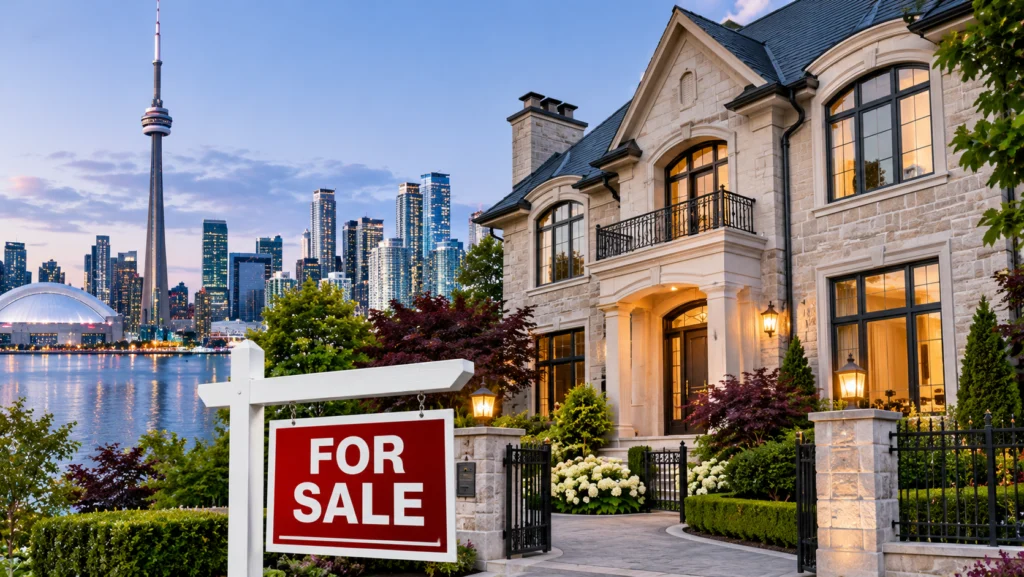
TORONTO — Recent reports from two real estate firms say Canada's luxury housing market had a difficult 2026, and that high-end properties, which are normally in strong demand, were not spared by buyer caution. Market experts attribute the caution to higher inflation, anxiety over the trade war and an unclear direction for borrowing costs.
Experts say 2027 could see a return of pent-up demand, as wealthy buyers look to purchase high-value properties.
Buyers negotiate, sellers wait
Real estate brokers said one dynamic repeated itself in luxury markets across Canada in 2026. Buyers had more room to negotiate, but sellers who could afford to wait held a stronger position, because they were willing to stay in their homes until they got their asking price. The finding appears in a new report from Engel & Völkers.
Andrew Carros, general manager and chief operating officer of Engel & Völkers Vancouver, said: "Sellers know the value of what they own." He described the market as "stubborn" and said sales volume there has dropped considerably since 2022.
He added: "We are seeing far fewer luxury properties listed, but what does sell is still selling for no more than 10 per cent below the asking price." He said this points to stable prices, because people are waiting until they get the value they consider appropriate.
Figures for Vancouver and Toronto
According to Engel & Völkers data, homes priced at $4 million and above in Vancouver had the slowest sales pace relative to newly listed properties between January and October. Sales reached 17 for every 100 new listings in this category, compared with 29 in the $2 million to $4 million category.
Carros said the issue is not only slower sales. Luxury properties now make up just over 15 per cent of new listings in the area he covers. When the market was at its peak, it was common for listings above $4 million to account for between 35 and 40 per cent of new listings.
Carros compared the luxury market to an engine that cannot run "because there isn't enough fuel." He said this market is driven by people who receive value from another source, such as family money or equity in a property they have owned for a long time, or by people who want to move into a smaller home. He added that the number of people able to move has fallen because of the economy and because of taxes imposed on these properties that raise their cost.
In Toronto, a higher municipal tax on transfers of residential properties valued above $3 million took effect on April 1. That prompted expectations that buyers of high-end properties would rush to complete their deals before the change took effect.
A Re/Max Canada report says difficult market conditions hit the traditional luxury hubs, Toronto and Vancouver, hardest, despite greater supply and more flexibility in negotiations. According to the company's data, about 850 sales of properties priced above $3 million were completed in the Greater Toronto Area in the first nine months of the year, a decline of 9.4 per cent from the same period last year. In the Vancouver area, slightly fewer than 600 homes sold in this price range, a decline of 17 per cent.
Smaller markets post growth
By contrast, smaller markets and resource-linked ones led year-over-year sales growth. Sales of homes priced above $2.4 million in Burlington, Ontario rose 26.3 per cent, and sales of homes at $1.5 million and above in Calgary rose 20.6 per cent. The price thresholds considered luxury vary from one region of Canada to another.
The top end of the Toronto market also went against the general trend. Fifteen properties sold for more than $10 million in the first nine months of the year, the highest activity at that price level in a decade.
Barry Cohen, a luxury real estate broker with Re/Max who took part in four of these "ultra-luxury" deals, said: "There is pent-up demand. I think many wealthy people stayed hesitant, waiting for better economic conditions."
Cohen explained that buyers initially showed what he described as a brief "rebellion" when the city began applying the higher tax, because they were reluctant to pay the new rates. But clients quickly realized that "it's not going to change, and I have to get on with my life."
Cohen said those who can afford the most expensive homes are "slightly more insulated" from global factors affecting inflation, the job market and borrowing costs, while a buyer of a $3 million property, who is on a lower rung of the luxury ladder, is "more exposed" to them. Carros, however, said these variables affect "all categories."
Carros said: "If the economy isn't good, it doesn't matter how much money you have, you will still be more cautious about what you do and how you do it." He added that economies have changed, the world is changing and technologies are different, to the point that people do not know whether their companies will remain viable in five to 10 years, and that this uncertainty has affected real estate markets globally.
Restrictions on foreign buyers
Cohen and Carros said continuing restrictions on foreign buyers are among the factors limiting luxury property sales. The federal government proposed in Budget 2026 to extend until 2029 the ban on purchases of existing residential properties by non-citizens and non-permanent residents. British Columbia imposes a 20 per cent tax on properties bought by foreigners.
The Re/Max report said the foreign buyer ban, in current conditions, "has sidelined affluent international buyers, such as corporate executives, international athletes and high-net-worth professionals, from investing in the upper-end markets," compounding the already weak overall activity.
Carros said: "In the end, I think the government has to look for ways to ensure investors come in." He added: "We need to see which problems get resolved before we see real optimism in the market."
What does this mean for the Arab community in Canada?
- The proposed federal ban on purchases of existing residential properties applies to non-citizens and non-permanent residents. Anyone living in Canada on a temporary basis should confirm their legal status before considering a purchase.
- British Columbia imposes a 20 per cent tax on properties bought by foreigners. Consult a lawyer or a licensed broker before any transaction there.
- Toronto has a higher municipal tax on transfers of residential properties valued above $3 million. Calculate the full cost of taxes and fees when estimating a purchase budget.
More from Hala Canada
- Youth and advocates urge MPs to fast-track Bill C-34 on social media safety for under-16s
- AI model detects signs of bladder cancer up to five years before diagnosis
- Canada is headed toward missing its Paris Agreement targets. Why won't the government say so?
- Luxury home sales fall in Toronto and Vancouver, but $10-million-plus sales hit a 10-year high in Toronto
- Canada expects clarity on Chinese auto investment in 2027, favours joint ventures
- New drug shows promise against pancreatic cancer in clinical trials, raising hopes in Canada