
New drug shows promise against pancreatic cancer in clinical trials, raising hopes in Canada
Early trial results for the U.S. drug daraxonrasib show tumours shrinking in many patients with advanced pancreatic cancer, but access in Canada remains uncertain and larger studies are still needed.
Translated from Arabic. Read the original بالعربية
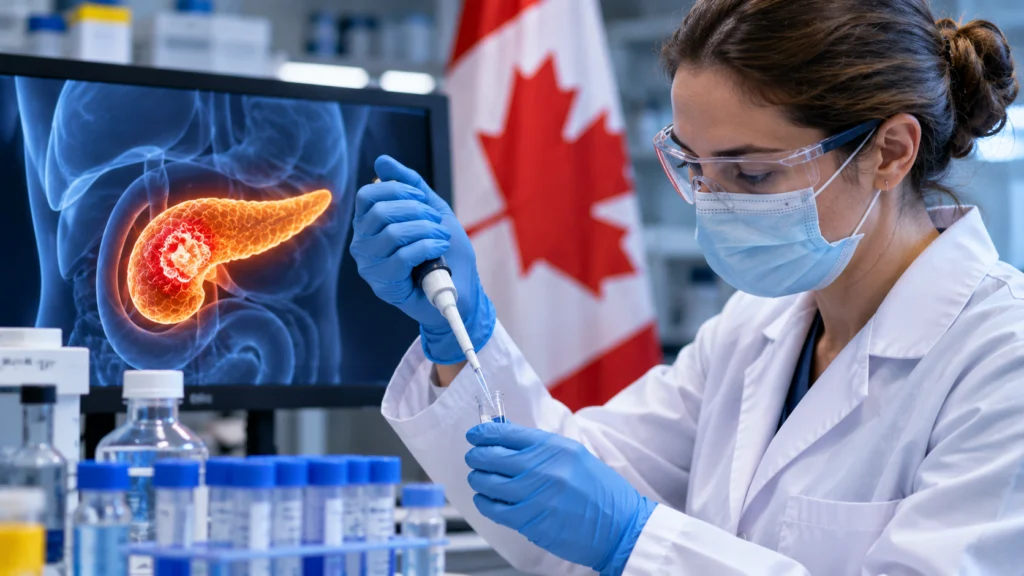
TORONTO — Clinical trial results for a new American drug to treat pancreatic cancer have raised wide optimism in medical circles, after it showed it could shrink tumours in a large number of patients with advanced stages of the disease.
Preliminary results show the drug, known as daraxonrasib, produced unusual responses in patients with metastatic pancreatic cancer when used with chemotherapy.
Researchers presented the new results on Friday at an international cancer treatment conference in Barcelona, Spain.
Encouraging results from a trial of 61 patients
The Phase 1 and Phase 2 study included 61 patients with metastatic pancreatic cancer who had not previously received treatment for the disease at the metastatic stage.
Participants received the new drug along with two types of chemotherapy, with a median follow-up of 18.3 months.
The main findings were as follows:
Tumours shrank in 60.7% of patients.
The disease was controlled in 90.2% of participants.
Tumours disappeared from imaging scans in 8.2% of patients.
76.6% of participants were alive one year after starting treatment.
Median progression-free survival was 12.8 months.
These results are considered encouraging compared with the usual outcomes of treatment for advanced pancreatic cancer, but they need to be confirmed in larger trials.
How does the new drug work?
Daraxonrasib targets proteins in the RAS family, which play a key role in the growth of cancer cells.
Genetic mutations in these proteins are linked to more than 90% of pancreatic cancer cases.
Targeting these proteins has been a major challenge for researchers for decades because it is difficult to disable their activity with conventional drugs.
The new drug works by inhibiting the signals that help cancer cells grow and multiply.
It can be taken by mouth, which makes it a different treatment option from many conventional therapies.
Drug previously nearly doubled survival time
A separate Phase 3 clinical trial involving 500 patients previously showed significant results for the same drug.
Median survival among patients who received the drug was 13.2 months, compared with 6.7 months among those who received conventional chemotherapy.
The U.S. Food and Drug Administration relied on these results to approve the drug on August 26, 2026.
The U.S. approval covers specific groups of adults with metastatic pancreatic cancer who have previously received systemic therapy or for whom multi-drug systemic therapy is not suitable.
Canadian doctor praises scientific progress
Dr. Jennifer Knox, a pancreatic cancer specialist in Canada, praised the results of the drug's earlier trials last June.
She said she wanted to open clinical trials in Canada so that as many patients as possible could gain access to the treatment.
She also pointed to the importance of studying use of the drug from the start of the treatment path, to determine whether earlier intervention could produce better results.
The latest results support continued research in this direction.
When will the new treatment be available in Canada?
Although the drug has received U.S. approval, access for Canadian patients remains a challenge.
The Heather Cutler Foundation announced on November 19 a national initiative calling on health authorities to make it easier for patients to obtain the drug.
The foundation said that, as of its announcement, no application to approve the drug in Canada had been submitted.
Patient advocacy organizations are calling for faster regulatory procedures and for new treatment options for people with this type of cancer.
The cost of the treatment and whether it could be covered under health insurance programs also remain important issues for Canadian patients.
Pancreatic cancer is among the deadliest cancers in Canada
According to the Canadian Cancer Society, pancreatic cancer is expected to rank third among the leading causes of cancer death in the country in 2026.
One of the difficulties in fighting the disease is that it is diagnosed late in many patients, because clear symptoms do not appear in its early stages.
Treatment options narrow when the tumour spreads to other organs, which makes it all the more important to develop treatments that can slow its progression and extend patients' lives.
Is the new drug a definitive cure for cancer?
Despite the encouraging results, the disappearance of tumours from medical scans does not mean a definitive cure.
The latest study remains small and did not include a direct comparison group to assess the effectiveness of the combination treatment.
Researchers need to follow patients for longer periods and study side effects and the possibility of tumours returning.
Success in future trials could change treatment strategies and open new avenues for developing drugs that target similar mutations in other types of cancer, including lung and ovarian cancer.
More from Hala Canada
- Canada expects clarity on Chinese auto investment in 2027, favours joint ventures
- Two people killed, third seriously injured in Scarborough shooting
- Pentagon imposes new limits on military co-operation with Canada, U.S. officials say
- Federal official says Chinese investment in Canada's auto sector will become clearer within a year
- U.S. senator says secret memo will not affect joint military operations with Canada
- CRA announces 2027 benefit payment dates: full schedule