
Canada expects clarity on Chinese auto investment in 2027, favours joint ventures
The federal government says the shape of Chinese investment in Canada's auto sector will become clear next year, and that it prefers joint ventures with Canadian partners.
Translated from Arabic. Read the original بالعربية
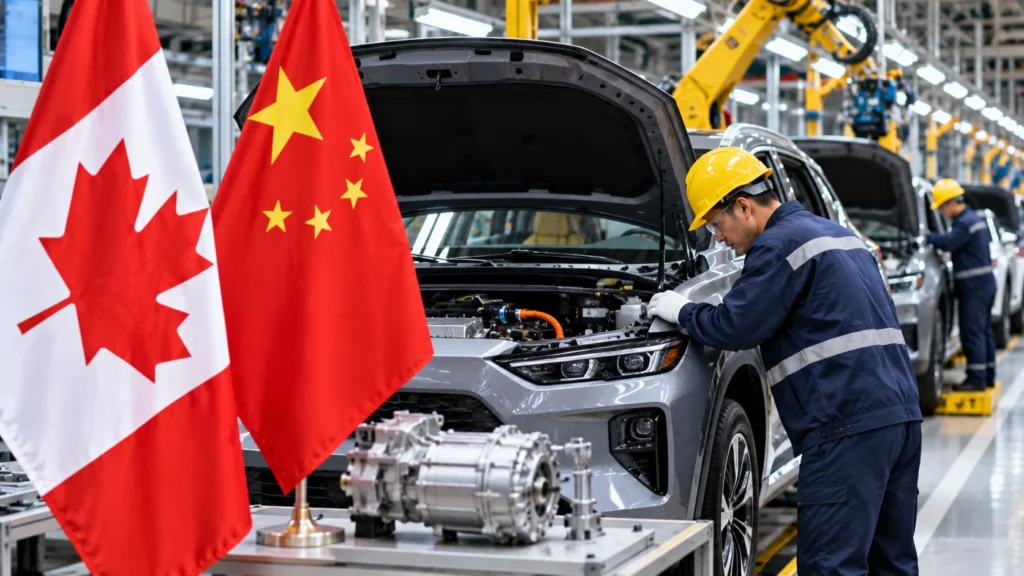
OTTAWA — The federal government says the future of Chinese investment in Canada's auto sector will become clear next year, as it seeks to diversify industrial partnerships and respond to the effects of U.S. trade policy.
The parliamentary secretary to Prime Minister Mark Carney said the government prefers joint ventures between Chinese companies and local partners, in line with the direction announced by Industry Minister Mélanie Joly.
The comments come amid growing pressure on Canada's auto industry from U.S. tariffs and concerns about the future of manufacturing jobs.
Ottawa wants Canadian companies involved
Cody Blois, parliamentary secretary to the prime minister, said the government is seeking a balance between protecting automakers already operating in Canada and attracting new investment.
The existing manufacturers include Ford, General Motors, Stellantis, Honda and Toyota.
Blois said the government wants to see Canadian capital contributions and genuine industrial partnerships in future Chinese projects.
This approach would allow local companies to take part in production and benefit from Chinese expertise and advanced technology in electric vehicle manufacturing.
About 17,000 Chinese electric vehicles imported
The official said about 17,000 Chinese electric vehicles have entered the country under the set quota since the start of this year.
Canada and China reached a trade agreement last January that allows the import of 49,000 Chinese electric vehicles a year at a tariff rate of 6.1%, instead of the previous additional tariff of 100%.
The government aims to allocate half of the import quota to electric vehicles priced at no more than $35,000 by 2030.
In return, Beijing agreed to reduce tariffs on a number of Canadian agricultural and seafood products, chief among them canola seed.
Doug Ford warns against simply assembling Chinese vehicles
Ontario Premier Doug Ford expressed concern about the future of domestic manufacturing after the announced sale of Stellantis's plant in Brampton to Roshel, a defence-industry company.
He called on the federal government to prevent the plant from being used to assemble electric vehicles whose components are mostly made in China.
Ford fears that adopting this industrial model would reduce job opportunities for Canadian companies and workers.
The federal government, for its part, says its goal goes beyond simple assembly and includes developing manufacturing capacity within the country.
Talks with a Chinese company on building a plant in Canada
The Canadian government recently confirmed it has held talks with China's Chery about the possibility of setting up an auto plant in the country.
Other Chinese companies, including BYD and Geely, have also shown interest in entering the Canadian market and expanding their commercial presence.
Such investment could create new opportunities for companies that make auto parts, batteries and electronic components.
However, the ongoing talks do not mean final decisions have been made on building new plants or on their locations and investment size.
U.S. tariffs push Canada toward alternatives
Canada's auto industry faces growing economic pressure from the tariffs imposed by U.S. President Donald Trump's administration.
About 90% of Canadian vehicle exports go to the U.S. market, which leaves the sector highly exposed to changes in Washington's trade policy.
Prime Minister Mark Carney has pointed to the possibility of expanding cooperation with Asian and European companies if a trade agreement protecting the future of Canada's auto industry cannot be reached.
Even so, maintaining industrial and trade relations with the United States remains one of the federal government's priorities.
National security and foreign interference concerns
The economic rapprochement between Ottawa and Beijing is taking place alongside continuing concerns about national security and foreign interference.
Blois said the government sees opportunities to strengthen cooperation with China in agriculture and clean energy, while strict controls are needed in sensitive sectors.
These sectors include defence, critical minerals and artificial intelligence.
Canadian authorities are seeking a balance between benefiting from economic opportunities and protecting national interests and democratic institutions.
2027 could be decisive for Canada's auto industry
The Canadian government is betting on new industrial partnerships to diversify sources of investment and strengthen the competitiveness of the auto sector.
Greater competition could widen the choices available to consumers and make electric vehicles more affordable.
But the success of this strategy will depend on the amount of investment that actually materializes and how much it contributes to local jobs, technology transfer and support for Canadian supply chains.
Economic and industrial circles are awaiting the outcome of the negotiations next year to see whether Ottawa can turn its closer ties with Beijing into tangible industrial projects without harming its trade relations with Washington.
More from Hala Canada
- New drug shows promise against pancreatic cancer in clinical trials, raising hopes in Canada
- Two people killed, third seriously injured in Scarborough shooting
- Pentagon imposes new limits on military co-operation with Canada, U.S. officials say
- Federal official says Chinese investment in Canada's auto sector will become clearer within a year
- U.S. senator says secret memo will not affect joint military operations with Canada
- CRA announces 2027 benefit payment dates: full schedule