
Carney avoids position on Quebecor's $31-billion bid for Telus, stresses competition
Prime Minister Mark Carney said competition, prices and service quality will guide any review of the proposed deal, without signalling approval, amid concerns over phone and internet bills.
Translated from Arabic. Read the original بالعربية
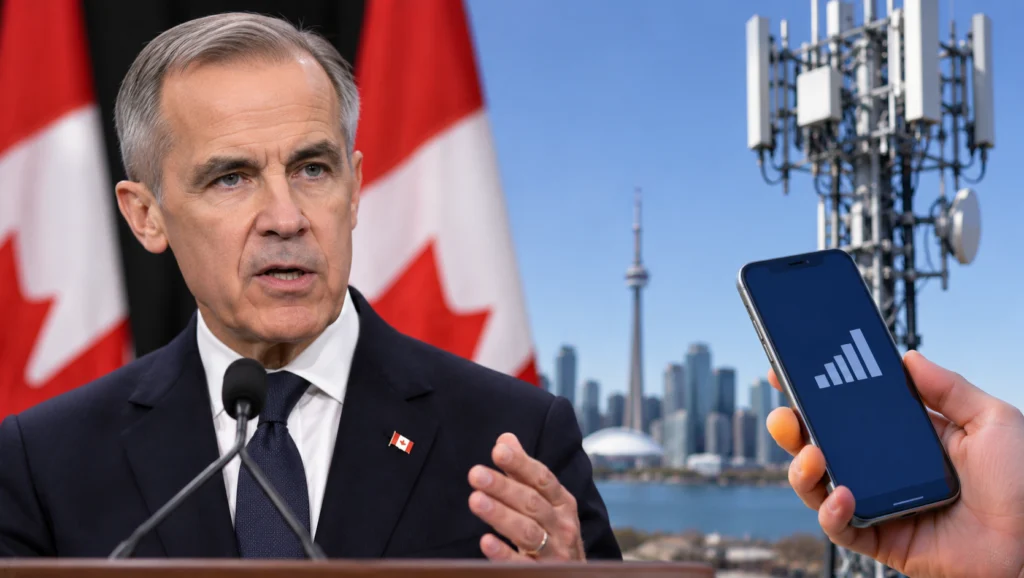
OTTAWA — Quebecor's bid to acquire Telus has prompted wide debate over the future of phone and internet services in Canada, after Prime Minister Mark Carney declined to take a clear position on the possibility of one fewer major national telecom company.
Speaking to reporters in China, Carney said the government will put competition, prices and service quality at the forefront of any assessment of a potential deal, without giving advance approval to a merger.
A deal that could change the telecom landscape
Quebecor, which owns the Videotron, Freedom Mobile and Fizz brands, announced a proposal to acquire Telus for about $31 billion.
Telus operates extensive networks and telecom services from Vancouver, while Quebecor is based in Montreal.
If the merger goes ahead as proposed without the sale of other assets, the number of major national competitors in the wireless market could fall from four to three: Rogers, Bell and the merged company.
This comes in a market where competition has remained a focus of government policy because of consumer complaints about prices.
What Mark Carney said
Carney declined to answer directly whether the telecom sector can do without one of its main players. He said that commenting on the number of companies could be taken as prejudging the proposed deal.
But he noted that some markets dominated by a few firms can, in certain circumstances, see stronger competition despite having fewer companies.
He said it depends on the structure of the market and how competitors operate, not on the number alone.
He said the government's standard will be lower prices, better services and stronger competition for Canadian consumers, taking into account technological developments that are changing the nature of the sector.
Details of the offer to Telus
Under the proposal, Telus shareholders would receive $6.35 in cash and 0.17 of a Quebecor Class B share for each share they hold.
When the offer was announced, the company valued the consideration at about $19.45 per share, roughly 60 per cent above Telus's closing price on Nov. 13.
However, that valuation is not a fully guaranteed cash amount, because a large part of the consideration depends on Quebecor's fluctuating share price.
Quebecor had made an initial offer in June, then a revised version on Nov. 9, before announcing it publicly.
Objections and regulatory reviews
Telus announced the formation of an independent committee to review the offer, while continuing to consider other strategic alternatives. It raised concerns about the value offered, the distribution of voting rights, and regulatory and financial risks.
It said it has not decided to approve the deal.
For its part, Quebecor says combining the two networks could lower costs and help fund investment in 5G technology and rural coverage.
It has pledged to keep Telus's headquarters in Vancouver, but those promises remain tied to a deal that has not been completed.
Will phone and internet bills rise?
There are so far no announced changes to customer contracts or service prices as a result of the offer alone.
Still, the possibility of fewer competitors raises questions about the strength of competition and the choices available to subscribers in the future.
Any final deal would require reviews by the Competition Bureau, the Canadian Radio-television and Telecommunications Commission (CRTC) and the bodies responsible for spectrum licences.
Carney noted that satellite technology and new internet services are also affecting competition, while the government reviews its own policies for the sector.
The issue carries particular weight because the government approved Rogers' acquisition of Shaw in 2023, after Freedom Mobile moved to Quebecor in order to preserve a fourth competitor in the market.
Bringing Freedom and Telus under one owner would therefore revive the questions that accompanied the earlier deal about protecting competition.
The entry of providers that use satellites also does not make traditional mobile services identical to satellite internet, which means each market must be examined separately before the effect of the merger can be assessed.
The matter thus remains a test of Ottawa's ability to balance encouraging investment with protecting consumers, before any formal decision is made.
More from Hala Canada
- KPMG Canada reports cyber incident involving unauthorized access to clients' tax documents
- Quebec has Canada's longest emergency room stays, Montreal Economic Institute report finds
- 61% of Toronto-area residents rate emergency room wait times as bad, poll finds
- Six outcomes of Carney's trip to Asia and Ireland, from Trump meeting to deals with China and the Philippines
- 22 chickens escape from truck in Toronto parking lot as firefighters step in to round them up
- Toronto drug checking program finds new synthetic opioid in fentanyl samples