
Canada and China agree to cut tariffs on $400 million in Canadian exports
Prime Minister Mark Carney and President Xi Jinping agreed to new tariff reductions covering about $400 million in Canadian exports, and Canada will extend exemptions on Chinese steel and aluminum until the end of 2028.
Translated from Arabic. Read the original بالعربية
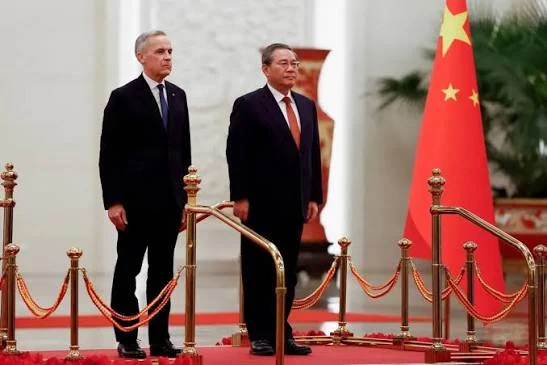
SHENZHEN — Prime Minister Mark Carney has announced a new agreement with Chinese President Xi Jinping to expand tariff reductions between the two countries, a move aimed at strengthening economic co-operation and opening additional markets to Canadian products.
The agreement came during talks between the two leaders on Tuesday in the Chinese city of Shenzhen, on the sidelines of meetings of the Asia-Pacific Economic Cooperation (APEC) forum.
According to an official statement from the Prime Minister's Office, China will grant additional tariff relief on Canadian exports worth about $400 million, including meat, fish and seafood products.
In return, Canada agreed to extend exemptions from some tariffs imposed on Chinese steel and aluminum products, and to widen their scope to include additional items.
The agreement is part of the Carney government's efforts to diversify trade relations and reduce the Canadian economy's reliance on the United States, amid continuing trade disputes with the administration of U.S. President Donald Trump.
Canadian exports worth $400 million to benefit
The Canadian government said the new reductions will cover agricultural and seafood products that had faced additional tariffs when entering the Chinese market.
According to government estimates, the value of the exports that will benefit breaks down as follows:
- Most frozen pork cuts: $116 million
- Certain types of frozen shrimp and prawns: $87.5 million
- Some marine molluscs: $61.4 million
- Sea cucumber: $39.4 million
- Greenland halibut: $96 million
The total value of these products is estimated at about $400 million.
The additional Chinese tariffs in question are to be suspended from January 1, 2027, to December 31, 2028.
The move is expected to help Canadian companies improve their competitiveness in the Chinese market, particularly in the agriculture and fisheries sectors.
Canada eases tariffs on Chinese steel and aluminum
In return, the Canadian government agreed to extend existing tariff exemptions for certain steel and aluminum products imported from China for another two years.
The exemptions were due to end on December 31, 2026, but will now continue until the end of December 2028.
The agreement also expands the exemptions to cover 32 additional tariff items, made up of 23 steel items and nine aluminum items.
Ottawa said the relief targets products for which there is insufficient Canadian production or no suitable domestic alternatives.
The agreement does not mean tariffs are being removed from all Chinese steel and aluminum imports. It is limited to specific items under the approved conditions.
Carney: market access restored for $7.5 billion in exports
Carney said economic relations between Canada and China have improved markedly since the two countries launched their new strategic partnership last January.
He said the two countries have succeeded in restoring market access for more than 90% of the trade that had been subject to earlier tariff measures.
The value of Canadian exports linked to these measures is about $7.5 billion.
The prime minister said the new phase of bilateral relations is built on strengthening stability and finding practical solutions to trade disputes.
He also noted that economic co-operation between the two countries is expanding in investment, trade and tourism.
For his part, Xi said that improving relations between Beijing and Ottawa serves the interests of both countries and helps strengthen stability and global economic growth.
Earlier agreement cut tariffs on Chinese electric vehicles
The new understanding follows an agreement reached by Carney and Xi in January 2026.
Under that agreement, Canada agreed to allow the import of up to 49,000 Chinese electric vehicles a year, within an initial quota subject to a 6.1% tariff.
Chinese electric vehicles were previously subject to an additional 100% tariff.
In return, China agreed to reduce tariffs on some Canadian agricultural products, particularly canola seed.
Other relief on Canadian exports, including canola meal, peas, lobster and crab, was also extended for another two years.
These arrangements are part of a broader process of rebuilding trade relations between the two countries after a period of tension and reciprocal restrictions.
Canadian trade mission to China in 2027
The results of the meeting were not limited to tariffs.
Carney announced that his government intends to send a large trade mission to China in 2027 to connect Canadian companies with Chinese investors and institutions.
The two countries also agreed to make 2027 a year of e-commerce between Canada and China.
The initiative aims to help small and medium-sized businesses reach Chinese consumers through digital platforms.
Ottawa is seeking to encourage Canadian organizations to take advantage of the Chinese market, which has more than 1.4 billion people.
New co-operation in education, aviation and energy
The announcements also included expanded co-operation in other sectors.
The Canadian government announced $850,000 to support scholarships that will allow 850 Canadian students to study at Chinese universities.
It also allocated $8 million over five years to support research and environmental co-operation with the China Council for International Cooperation on Environment and Development.
In aviation, Air Canada announced plans to launch new flights between Vancouver and Guangzhou starting in May 2027.
The two leaders also welcomed expanded co-operation in conventional and renewable energy, clean technology and financial services.
The government says these initiatives are aimed at easing the movement of trade, investment and people between the two countries.
Will closer ties with China affect negotiations with Trump?
The agreement comes at a sensitive time in trade relations between Canada and the United States.
Ottawa faces challenges tied to U.S. tariffs and the future of the auto industry, particularly in Ontario.
Carney had announced that Canada is prepared to consider new industrial partnerships with Chinese, European and Japanese automakers if negotiations with Washington do not ensure the continuation of a strong Canadian auto industry.
The government maintains, however, that diversifying trade partnerships does not mean abandoning the economic relationship with the United States.
Canada is seeking to widen its export markets and reduce the exposure of domestic companies to the risks of depending on a single trading partner.
According to government data, merchandise trade between Canada and China totalled $125.6 billion in 2025, an increase of 5.6% from 2024.
A new phase in relations between Ottawa and Beijing
The latest agreement reflects a shift in the course of Canada-China relations after years of trade and diplomatic tension.
The new understandings include lower tariffs, easier trade, encouragement of investment and expanded co-operation in education and technology.
However, the actual economic results will depend on the implementation of the agreed measures and on how companies and investors respond to the new opportunities.
With the additional tariff reductions taking effect at the start of 2027, the agriculture and fisheries sectors are likely to be among the main beneficiaries of the reopening of the Chinese market to additional Canadian exports.
More from Hala Canada
- Quebecor's $31-billion bid for Telus raises concerns about phone bills and competition
- Canadian home sales fall 10.6% year over year in October; average price drops to $678,584
- Experts warn parliamentary committee that AI pricing could raise grocery costs for some Canadians
- 54% of Toronto residents want Sankofa Square's old name restored
- Canadians plan holiday spending despite financial pressure, CPA Canada survey finds
- Trillium College resumes classes for students who can pay, keeps others out of the classroom