
Poll: Most Canadians oppose a U.S. trade deal that keeps tariffs on Canadian goods
A new Nanos Research poll finds only 33.3% of Canadians support a trade agreement with the United States that leaves tariffs on Canadian products, as pressure grows on Mark Carney's government.
Translated from Arabic. Read the original بالعربية
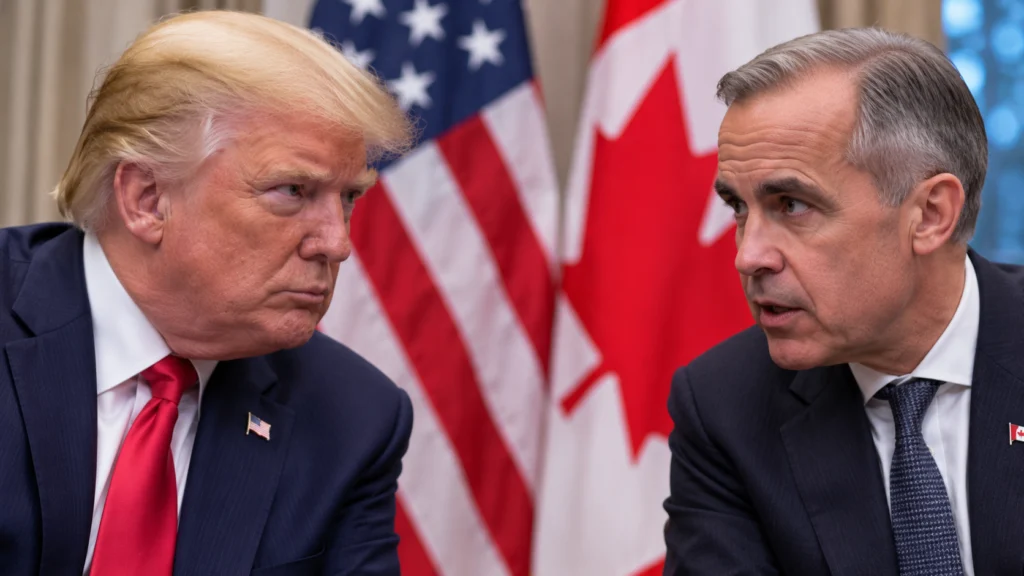
OTTAWA — A new public opinion poll shows that most Canadians do not support a trade agreement with the United States if it includes continued tariffs on Canadian products, a sign of growing public opposition to making concessions to the administration of U.S. President Donald Trump.
The poll, conducted by Nanos Research, found that only 33.3% of Canadians support a trade agreement that allows tariffs on Canadian goods to remain in place.
That is a decline from August 2025, when support stood at about 41%.
The results come as Prime Minister Mark Carney's government steps up efforts to reach a trade understanding with Washington while insisting on protecting Canadian industries and jobs.
Support for deals that keep tariffs has fallen
The Nanos results indicate that Canadian public opinion has become less willing to accept a trade agreement that does not address the tariffs imposed on national exports.
While about four in every ten Canadians supported such an agreement in August 2025, the share fell to about one in three in the new poll.
The decline reflects continuing concern about the effects of U.S. trade policies on the Canadian economy.
It also puts the federal government in a position of having to balance the need for stable trade relations with the United States against residents' demands for an agreement that protects the country's economic interests.
The results show that reaching an agreement alone does not guarantee broad public support if the tariffs on Canadian products remain in place.
Why Canadians are rejecting concessions to Trump
The public opposition comes amid ongoing trade disputes over U.S. tariffs and their effect on important Canadian industrial sectors.
Concerns include the future of auto plants and the steel and aluminum industries, as well as the burdens borne by companies that depend on exporting to the U.S. market.
Critics of the tariffs fear that their continuation will weaken the ability of Canadian companies to compete and lead to a decline in investment and jobs.
Supporters of reaching a settlement, on the other hand, argue that a continued trade confrontation could impose additional costs on the economy, businesses and consumers.
These positions reflect the challenges Ottawa faces in weighing the potential gains of any new agreement.
Europe and Asia offer Canada new trade options
International trade lawyer Barry Appleton says growing international interest in Canada may explain part of the shift in residents' views.
He noted that Canada is receiving trade interest from European countries and partners in Southeast Asia, in addition to talks with India.
The Carney government is working to expand its economic ties with these markets in order to reduce the country's dependence on the United States.
The prime minister took part in Asian meetings in recent days that focused on developing trade agreements and attracting investment.
These moves give Ottawa opportunities to diversify its exports, but they do not provide an immediate alternative to the U.S. market.
70% of Canadian exports go to the United States
Despite the opportunities for trade diversification, Appleton warned that geography and economic ties make the relationship with the United States extremely important to Canada.
He explained that about seven of every ten dollars of Canadian exports still go to the U.S. market.
That dependence makes ending the trade disputes an economic necessity, even as relations with Europe and Asia expand.
He also noted that Washington has imposed tariffs on a number of its major trading partners, which makes a full exemption a difficult negotiating goal.
Canada therefore faces a complicated choice between rejecting an agreement that includes tariffs and continuing to negotiate to reduce the economic damage.
Carney says progress is being made in talks
The publication of the poll results coincided with new statements by the prime minister on the negotiations with the United States.
Speaking at a news conference in the Philippine capital, Manila, on Saturday, Carney said he had an important conversation with U.S. President Donald Trump before leaving on his international tour.
He said the two sides continue to work on outstanding trade issues.
He also stressed that Canada will not agree to a deal that does not guarantee the continuation of a competitive domestic auto industry.
That position reflects the importance of the manufacturing sector to the government, particularly in Ontario, where many communities depend on auto industry jobs.
Will a deal be reached before the end of 2026?
U.S. Ambassador to Canada Pete Hoekstra expressed optimism that a trade agreement could be reached before the end of the year.
That optimism does not mean the negotiations are over or that the two sides have reached a final settlement.
Tariffs and the future of industrial sectors remain among the main issues that need to be resolved.
The poll results suggest that the Carney government could face public objections if it accepts an agreement that leaves significant restrictions on Canadian exports in place.
On the other hand, continued negotiations without an agreement could prolong the period of uncertainty for businesses and investors.
As the end of 2026 approaches, the key question is whether the two sides can reach a settlement that delivers economic stability without making concessions that provoke widespread opposition within Canada.
More from Hala Canada
- Two Soup Time soups recalled in Canada over undeclared wheat
- Carney announces up to $560 million to protect tropical forests worldwide
- Carney arrives in Cambodia for Francophonie summit ahead of meeting with Quebec premier
- Internal government memo warns freshwater pressures threaten Canada's security and economy
- Carney announces progress on two Asian trade deals, with potential for 14,000 Canadian jobs
- Canada to spend $433 billion on health care in 2026 as pressure on doctors and hospitals continues