
Toronto ER doctor warns of 10-hour waits to see a physician as hospitals fill up
An emergency physician who works at three Toronto hospitals says patient volumes are at exceptional levels, with some people waiting 10 hours to see a doctor and more than 15 hours in the department overall.
Translated from Arabic. Read the original بالعربية
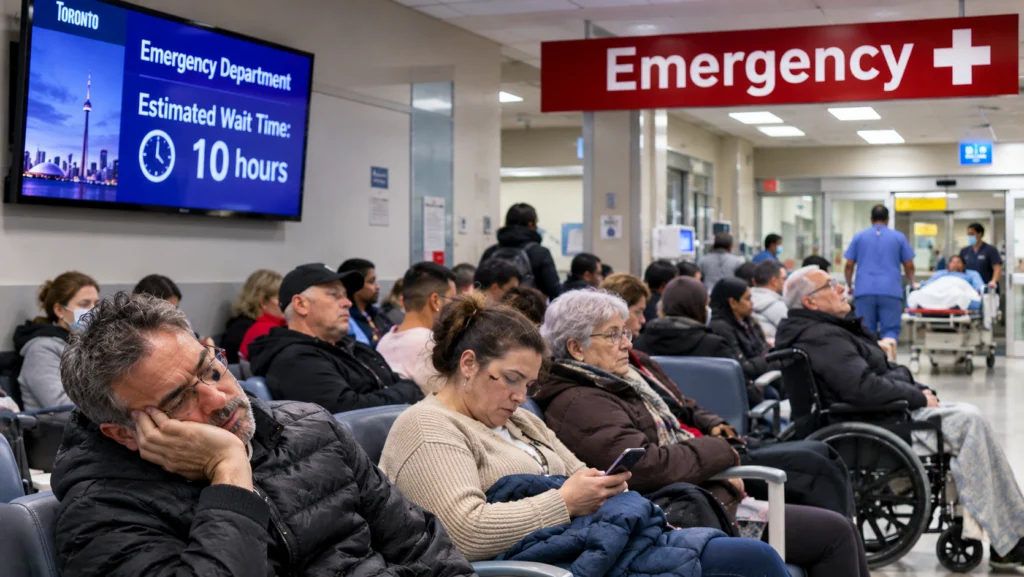
TORONTO — An emergency physician who works at several Toronto hospitals has warned that patient numbers have reached exceptional levels, with waits of up to 10 hours in some cases, despite government efforts to increase hospital capacity.
Dr. Raghu Venugopal, who has 19 years of experience in emergency medicine, said the current pressure is exhausting for doctors and nurses, particularly because of the large number of patients who cannot get medical care elsewhere.
The warnings come ahead of the peak of respiratory illness season, raising concerns that overcrowding could worsen in the coming weeks.
Patients waiting 10 hours to see a doctor
Venugopal, who works at three Toronto hospitals, said some patients wait four, seven or eight hours before seeing a doctor.
He added that in certain cases the wait can reach 10 hours, not counting the time needed for tests, results and treatment.
He said some patients' total time in the emergency department can exceed 15 hours.
He noted that working a night shift in the department has become a gruelling experience, as doctors sometimes face between 50 and 100 patients waiting for care.
These numbers place heavy psychological and professional strain on medical teams, who try to treat cases according to their severity.
Troubling numbers at Toronto hospitals
Data published by Toronto hospitals on the morning of Thursday, Nov. 12, showed a sharp rise in wait times.
At Toronto General Hospital, the posted average wait was close to seven hours, while it was five hours and 42 minutes at Toronto Western Hospital.
Sunnybrook Hospital recorded three hours and 47 minutes in the morning, before the wait rose to six hours and 55 minutes by 3 p.m.
By contrast, the posted wait at Toronto General and Toronto Western fell to about three and a half hours in the afternoon.
North York General Hospital also posted a warning about a high number of patients, urging visitors to expect longer waits than usual.
These figures show that wait times change over the course of the day and are not a fixed length for all patients.
Difficulty reaching a family doctor adds to the crisis
Venugopal attributed much of the pressure to the limited alternatives available to patients who need a quick medical assessment.
He said some people already have a family doctor but cannot get an appointment for three weeks.
These patients end up having to go to the emergency department, even when their conditions are not among the most serious.
The doctor also said hospitals are short of doctors, nurses, imaging services and available beds.
The problem becomes more complicated when patients who need to be admitted remain in emergency departments because no beds are available in other units.
Calls for additional hospital funding
The doctor called on the Ontario government to increase funding for emergency care and to boost the number of doctors and nurses during busy periods.
He acknowledged that Doug Ford's government has added 3,000 beds and plans to provide another 3,000, but said the increase has not kept pace with growing needs.
He said an aging and growing population and increasingly complex medical cases are contributing to the pressure on hospitals.
He also pointed to the Ontario Hospital Association's call for $2.7 billion in funding to help stabilize the health system.
In October, the provincial government announced more than $47 million for a new team aimed at reducing wait times and improving patient flow at 26 hospitals.
Warnings ahead of flu and virus season
Venugopal warned that hospitals remaining full ahead of the peak of respiratory illness season could lead to longer waits.
He urged residents to get flu and COVID-19 vaccines to reduce the chances of severe illness requiring hospitalization.
But he stressed that people should not avoid emergency departments when they need them, saying patients are not to blame for the overcrowding.
Emergency departments in Ontario assess the severity of each case, so patients who most need urgent attention are given priority regardless of the order in which they arrive.
Increasing capacity and improving access to primary care remain among the main challenges facing the province's health system.
More from Hala Canada
- Several dead in boat incident in Squamish area amid B.C. flooding
- McGill researchers uncover network of 293 fake accounts posting AI videos aimed at Canadians
- More than 70,000 Quebec students authorized to strike over cost of living, education funding
- Brampton family seeks to raise $5.5 million for gene therapy that could change son's life
- Provinces have 139 days to nominate tens of thousands of workers for permanent residence
- Montreal police dismantle $3.9-million gold theft network, arrest 14 including six teens