
More than 70,000 Quebec students authorized to strike over cost of living, education funding
Student groups say more than 70,000 students in Quebec have strike mandates for Friday, as a large demonstration is planned in downtown Montreal over student aid, funding and living conditions.
Translated from Arabic. Read the original بالعربية
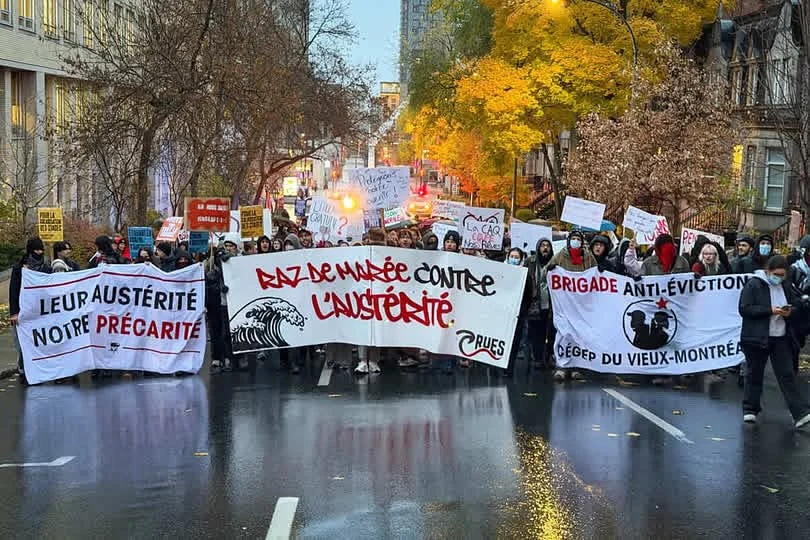
MONTREAL — Quebec is seeing a wave of student strikes, with tens of thousands of university and college students taking part to protest rising living costs and declining funding for higher education. A large demonstration is planned for downtown Montreal on Friday.
Student organizations say more than 70,000 students have received mandates to take part in the November 13 strike, following a week of protest action that began on Monday, November 9.
The mobilization aims to pressure the Quebec government to reform the student financial assistance system, increase investment in educational institutions and improve living conditions for students facing growing difficulties.
Large demonstration in downtown Montreal
The Coalition de résistance pour l'unité syndicale étudiante (CRUES), working with student associations, has called a demonstration at Victoria Square in downtown Montreal at 2 p.m. on Friday.
The demonstration comes at the end of a week of strikes and protest activities at educational institutions across the province.
According to the organizers, about 78,000 students took part in a strike for at least one day during the week, while more than 70,000 received mandates to strike on Friday.
The movement is calling for an end to austerity policies, better affordability of education and housing, and adequate financial aid for students.
Students demand reform of financial aid
Demands to reform Quebec's student financial assistance program (AFE) top the list of issues behind the protests.
Student organizations argue that current grants are not enough to cover basic needs, especially as rent, food and transportation prices rise.
According to figures cited by the movement, maximum grants for the 2026-2027 school year reach $18,415 for college students and $23,033 for university students.
The associations consider these amounts to be below the income levels needed to cover living costs, although students' circumstances and sources of income differ.
They are also calling for a review of eligibility criteria and for larger amounts for students with the greatest need.
Calls for pay during mandatory internships
The demands are not limited to grants. Student organizations are also calling for pay for all mandatory internships.
The associations say some students have to work during internships without pay, even though they bear the costs of housing, transportation and study.
They are also calling for more government funding for universities and colleges, better academic and mental health support services, and affordable student housing.
The movement says reduced investment in educational infrastructure affects the quality of studies and of the services offered within institutions.
Concerns over the state of educational institutions
Student organizations say about 65% of the buildings in Quebec's public college network are in poor or very poor condition.
They also say the maintenance deficit for educational facilities stands at about $701 million.
One example that has raised concern is Cégep de Saint-Laurent, where a building has been closed since August and two others are partially closed because reinforcement work is needed.
The protesters say these problems reflect a continuing lack of investment and directly affect the learning environment.
Protests recall Quebec's historic strikes
CRUES is tied to the union legacy of the student movements that led the 2012 protests in Quebec, when the red square became a symbol of opposition to tuition increases.
The symbol has reappeared in the current protests, signalling rejection of the rising financial burden on students.
A group of protesters entered a government building in Montreal during the week to protest higher education policies.
Montreal police said no arrests were made in connection with the incident, and an investigation has been opened.
The movement warns that it could escalate its protests in 2027 if the government does not respond to its demands.
Will the Quebec government respond?
The strikes put the Quebec government under growing pressure to review its policies on higher education funding and student aid.
The participating organizations say the aim of the action is not to disrupt studies, but to improve the conditions that allow students to continue them without facing financial crises.
With the results of Friday's demonstration still to come, the scale of the government's response will be a key factor in determining the future of the protests and whether they expand in the coming months.
More from Hala Canada
- Several dead in boat incident in Squamish area amid B.C. flooding
- McGill researchers uncover network of 293 fake accounts posting AI videos aimed at Canadians
- Brampton family seeks to raise $5.5 million for gene therapy that could change son's life
- Provinces have 139 days to nominate tens of thousands of workers for permanent residence
- Montreal police dismantle $3.9-million gold theft network, arrest 14 including six teens
- House fire in Scarborough: person found without vital signs