
McGill researchers uncover network of 293 fake accounts posting AI videos aimed at Canadians
A McGill University report found 293 TikTok and Instagram accounts that posted 3,201 AI-manipulated videos, drawing 22.1 million views, to sway Canadian public opinion, especially on the trade war with the U.S.
Translated from Arabic. Read the original بالعربية
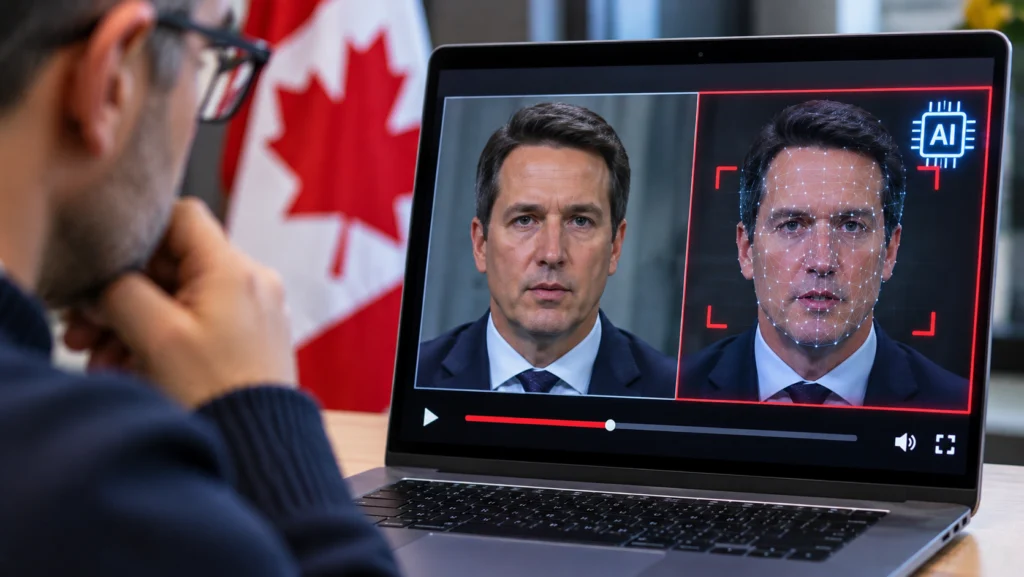
MONTREAL — Researchers at McGill University have uncovered a large network of fake accounts that use artificial intelligence to impersonate real influencers and spread misleading political information aimed at Canadians, particularly about the trade war with the United States.
A report from the university's Centre for Media, Technology and Democracy found that the network includes 293 accounts on TikTok and Instagram. They posted 3,201 videos that drew 22.1 million views over three months.
The researchers warned that the operation exploits the public's trust in familiar figures to spread contradictory narratives, which could deepen political and social divisions in Canada.
A network of 293 fake accounts
The report, titled "Stolen Faces" and published Thursday, Nov. 12, describes an organized operation that began on Aug. 7.
The accounts identified were split between 257 on TikTok and 36 on Instagram.
During the monitoring period, the network expanded quickly and was eventually posting about 100 videos a day.
The researchers said all of the accounts identified were still active as of Nov. 11, which suggests the operation is continuing despite the wide reach of its content.
The report noted that the figures may understate the true size of the network, since there may be accounts the researchers were unable to detect.
How do hackers use influencers' faces?
The network relies on stealing real videos of influencers, then altering lip movements with artificial intelligence and adding synthetic voices that say words the people in the clips never said.
One example the researchers found was a clip of American influencer Ashley Hetherington, who was originally talking about personal relationships.
The fake account reused her image and made her speak about Canadian job losses, U.S. tariffs and the Alberta referendum.
The researchers also found clips of financial influencer Andrei Jikh, with the words attributed to him changed in several videos.
The report explained that this technique makes manipulation harder to detect because the faces and bodies come from real recordings.
False claims about Trump and Carney draw millions of views
The network focused mainly on Canada-U.S. relations, with 84 per cent of the videos dealing with Canada-related issues.
The trade war and tariffs accounted for 71 per cent of total views.
Among the most prominent falsehoods the researchers identified was a claim that U.S. President Donald Trump gave Canada a 48-hour deadline, after which Prime Minister Mark Carney responded by cancelling U.S. defence contracts worth $8 billion.
The report stated that this never happened.
Even so, the story spread through 161 videos on 129 accounts and drew 5.1 million views.
The network also used contradictory narratives, at times attacking the Canadian government and at other times criticizing the United States, with the aim of provoking controversy.
93% of comments do not question the videos' authenticity
The researchers' review showed that only 6.3 per cent of the comments they examined suggested the videos might be fake or AI-generated.
The remaining comments engaged with the content without clearly questioning its authenticity.
The report found that about one in 10 commenters addressed the person in the video as though they were a real person speaking directly.
It also found that TikTok's system applied an AI label to only four per cent of the videos that used altered faces of real people.
The researchers say this shortcoming makes it easier for the disinformation to reach audiences.
Is a foreign party behind the network?
The researchers said the network is likely run from outside North America, based on the timing of the videos and of the accounts' creation.
The data showed activity dropping during night hours in East and Southeast Asia.
Some accounts also had Chinese-language settings or registration data linked to China.
The report stressed, however, that these indicators do not prove that the Chinese government or any other country is responsible for the operation.
The researchers were unable to determine who the operators are or their ultimate motives, whether political, commercial or tied to building an audience to be used later.
Warnings about the effect of disinformation on Canadian democracy
The Centre for Media, Technology and Democracy warned that using real faces to spread fabricated statements could affect political debate and elections.
It called for stronger tools to detect synthetic content and greater protection for people whose images are used without their consent.
It also stressed the importance of giving researchers and journalists access to platform data, to help detect coordinated disinformation networks.
The report says the challenge is no longer limited to telling real images from fake ones, but now extends to verifying statements attributed to well-known people.
More from Hala Canada
- Several dead in boat incident in Squamish area amid B.C. flooding
- More than 70,000 Quebec students authorized to strike over cost of living, education funding
- Brampton family seeks to raise $5.5 million for gene therapy that could change son's life
- Provinces have 139 days to nominate tens of thousands of workers for permanent residence
- Montreal police dismantle $3.9-million gold theft network, arrest 14 including six teens
- House fire in Scarborough: person found without vital signs