
Federal official says Chinese investment in Canada's auto sector will become clearer within a year
Kody Blois says any partnership would take the form of a joint venture with Canadian equity, and that Canada has the tools and institutional strength to counter Chinese foreign interference.
Translated from Arabic. Read the original بالعربية
TORONTO — Kody Blois, parliamentary secretary to Prime Minister Mark Carney, said the course of Chinese investment in Canada's auto manufacturing sector will take shape over the coming year. He made the remarks in a television interview broadcast Sunday morning.
Blois said the government wants to protect manufacturers already operating in Canada, whether the Detroit Three (Ford, General Motors and Stellantis), Honda or Toyota. He added that the government also sees room to attract more industrial investment from Chinese companies. "I think that will become clear over the next year," he said.
Electric vehicles
Carney visited China this week and met Chinese President Xi Jinping ahead of the Asia-Pacific Economic Cooperation (APEC) summit. The bilateral meeting produced a new trade agreement covering tariffs on pork, seafood, and steel and aluminum products.
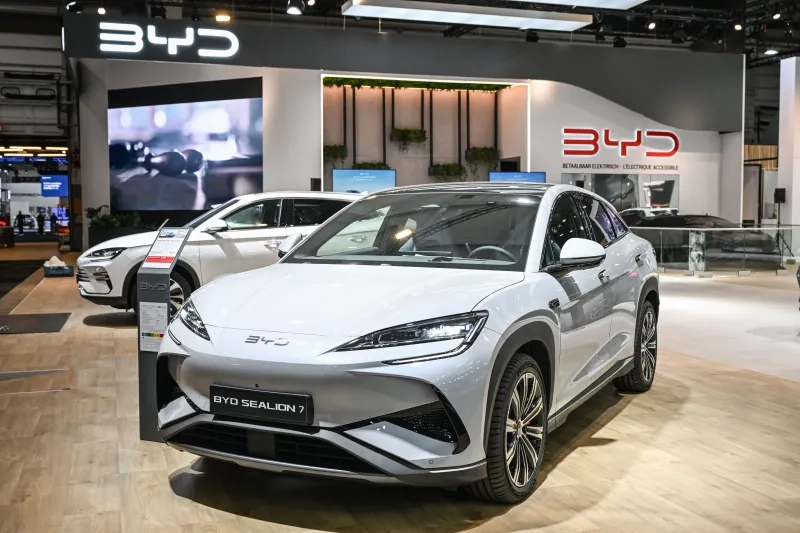
There has been no new development on electric vehicles, however, since the agreement Carney announced with Xi in January. Under that agreement, Canada cut its tariff on Chinese electric vehicles from 100 per cent to 6.1 per cent and allowed up to 49,000 Chinese-made electric vehicles into the country each year. In return, China lowered its tariffs on key agricultural and seafood exports, most notably Canadian canola seed.
Speaking to reporters in Cambodia before the summit, Carney had hinted that he would consider Chinese investment in Canada's auto manufacturing sector if U.S. tariffs continued to disrupt the North American market.
Asked about the U.S. administration's strong opposition to Chinese electric vehicles entering the American market, Blois said he sees "a path for investment" regardless of that position. He added that talks must continue and that "practical evidence" is needed on sales of Chinese electric vehicles in Canada.
He noted that Industry Minister Mélanie Joly has made clear the framework would be a joint venture. "We want to see Canadian equity and a Canadian partnership, and we believe that is possible," he said.
Brampton plant and assembly kits
Stellantis had sold its assembly plant in Brampton, Ontario, to defence equipment manufacturer Roshel. Ontario Premier Doug Ford then asked the federal government to ensure that Chinese electric vehicle kits would not be assembled at the plant.
A Chinese electric vehicle kit is a vehicle built mostly in China and then shipped to another country, such as Canada, in parts to be assembled there into a finished vehicle.
Blois said the government's focus is not only on such kits but on manufacturing and assembly generally. "We believe this path is possible, but we are still at the early stages," he said. According to him, only about 17,000 vehicles of the allotted quota have entered Canada so far this calendar year.
Foreign interference
The interview also addressed the government's plan to prevent Chinese interference in Canadian affairs, amid concerns some experts have raised about public safety as ties between the two countries deepen. Blois stressed that Canada has tools to counter such interference.
Asked why the reset in relations with China had not led to a decline in foreign interference, he said the prime minister's work is based on the need to return to a level of engagement. He added that without meetings between leaders, there is no ability to sit down with Chinese officials for frank discussions.
A 2025 report by Justice Marie-Josée Hogue, commissioned by the public inquiry into foreign interference, concluded that China is "the most active perpetrator of foreign interference targeting Canada's democratic institutions."
Blois said his government's position is that there are areas where the partnership with China can be strengthened, including clean energy and agriculture. Other areas, he said, require "safeguards": defence, critical minerals and artificial intelligence.
Asked why engagement with China had not produced better results on national security, he said it is important for Canada to have a seat at the table to raise these concerns in the first place. He added that Canada has its own security record and the ability to counter cyber threats, which is why it is investing in defence. He said Canada has "mechanisms" and "institutional strength" to counter foreign interference.
What does this mean for the Arab community in Canada?
- No new decision has been made on Chinese electric vehicles. The agreement announced in January remains the reference point, allowing up to 49,000 vehicles a year at a 6.1 per cent tariff.
- Anyone considering buying an electric vehicle can follow upcoming government announcements, as the official said the course of Chinese investment in the sector will become clear over the next year.
More from Hala Canada
- Two people killed, third seriously injured in Scarborough shooting
- Pentagon imposes new limits on military co-operation with Canada, U.S. officials say
- U.S. senator says secret memo will not affect joint military operations with Canada
- CRA announces 2027 benefit payment dates: full schedule
- Canada's defence minister says military co-operation with U.S. continues despite reports of new restrictions
- Two former Montreal police officers arrested in probe into racism allegations at Station 39