
Carney and Trump meet for about 20 minutes in China to discuss trade dispute
The two leaders agreed to keep working and stay in close contact on a trade deal, but no final agreement on tariffs or timeline for ending the dispute was announced.
Translated from Arabic. Read the original بالعربية
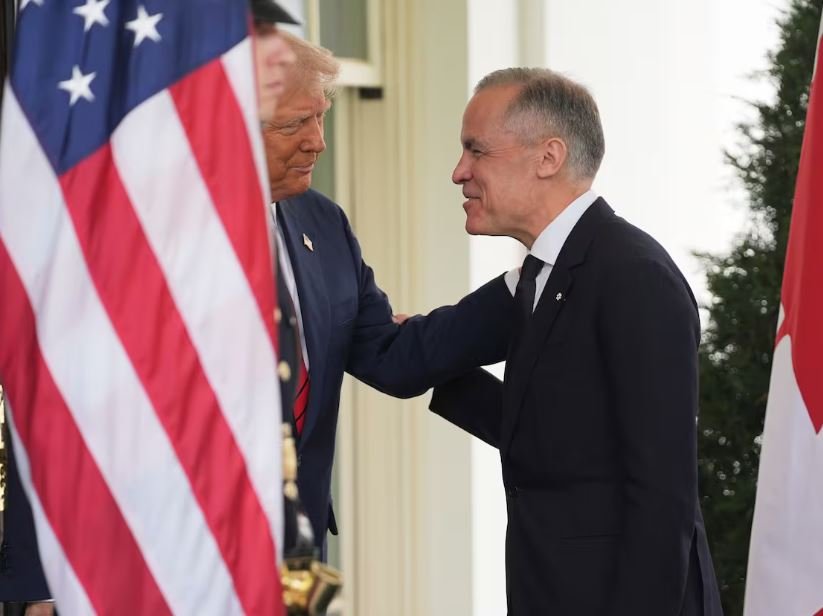
SHENZHEN — Prime Minister Mark Carney met U.S. President Donald Trump on the sidelines of the Asia-Pacific Economic Cooperation (APEC) summit in the Chinese city of Shenzhen to discuss the future of trade relations between the two countries, after months of tension and disagreement over tariffs.
The Prime Minister's Office said the two leaders discussed ongoing efforts to reach a trade agreement that serves mutual interests, helps create jobs and improves purchasing power, while respecting Canada's sovereignty, languages and culture.
The two sides agreed to continue working and to stay in close contact. No final agreement or specific date for ending the trade disputes was announced.
A meeting of about 20 minutes
The meeting lasted less than 20 minutes and included a number of senior officials from the Canadian and American governments.
The U.S. delegation included Secretary of State Marco Rubio, Commerce Secretary Howard Lutnick, Trade Representative Jamieson Greer and Stephen Miller, the White House chief of staff.
On the Canadian side, Minister of Foreign Affairs Anita Anand and Marc-André Blanchard, chief of staff in Carney's office, took part.
The presence of officials responsible for trade and foreign policy reflects the importance of the issues on the table, particularly as U.S. tariff measures continue to affect Canadian businesses.
The meeting followed a news conference in which Carney spoke about the progress made in negotiations, despite continuing obstacles to a comprehensive understanding.
Carney acknowledges difficult talks
The prime minister acknowledged that talks with the United States are advancing in fits and starts, explaining that some positive steps are met with new setbacks.
He noted that the economic relationship between the two countries is extremely complex because of the close links between industrial sectors, supply chains and cross-border investment.
He said this complexity makes negotiating with Washington different from the trade understandings Ottawa recently reached with China.
The Canadian government is under pressure to protect its exports, particularly in the auto, steel and aluminum sectors, which have been affected by U.S. tariffs.
Tariffs hold up a deal
The talks come after a round of negotiations between Ottawa and Washington collapsed last August, which led to rising tensions and additional tariffs on billions of dollars' worth of Canadian goods.
Canada is seeking exemptions from tariffs of up to 50 per cent on some products, including steel and aluminum.
The future of tariffs on vehicles is also raising wide concern in Ontario, where thousands of jobs depend on the auto and auto parts industry.
Trump had threatened to raise tariffs on Canadian vehicles to 50 per cent, after they reached 25 per cent.
The statement issued after the meeting did not announce any reduction or suspension of these tariffs.
Closer ties with China raise questions
The meeting coincided with Canadian moves to strengthen economic ties with China, after Carney and Chinese President Xi Jinping reached understandings to ease some trade restrictions.
The understandings cover agricultural and industrial products, including Canadian pork and Chinese steel.
Carney said he does not believe Trump is greatly bothered by the expansion of trade relations between Ottawa and Beijing.
The Canadian government is trying to diversify its foreign markets and reduce its exports' dependence on the United States, without abandoning its core economic partnership with Washington.
Is a new agreement close?
The meeting did not reveal a decisive breakthrough in the negotiations, but it showed that direct communication between the two leaders is continuing after a period of disagreement.
Carney's office said both sides will keep working toward an agreement that delivers economic benefits and respects Canadian sovereignty.
That means the main issues, chiefly tariffs and the protection of domestic industries, still require further negotiation.
Canadian businesses are watching the outcome of the talks, given their potential effect on investment, jobs and prices.
The key question remains whether the political contacts will turn into concrete trade concessions, or whether the uncertainty affecting economic relations between the two countries will continue.
More from Hala Canada
- Explosion and fire in Glace Bay, Nova Scotia, collapse building and injure about 17 people
- Health Canada recalls four lots of PegLyte bowel preparation powder over possible foreign matter
- Ontario to raise minimum fines for loud vehicle noise offences from $60 to $200
- Rabid bat found in Quebec long-term care home; province works on urgent plan
- Carney says trade talks with China are easier than with the U.S., plans to meet Trump
- Canada tests Alert Ready emergency alert system across all provinces today