
Canada tests Alert Ready emergency alert system across all provinces today
The national test of Alert Ready will send sound alerts and test messages to phones, televisions and radios in every province and territory, at times that vary by region.
Translated from Arabic. Read the original بالعربية
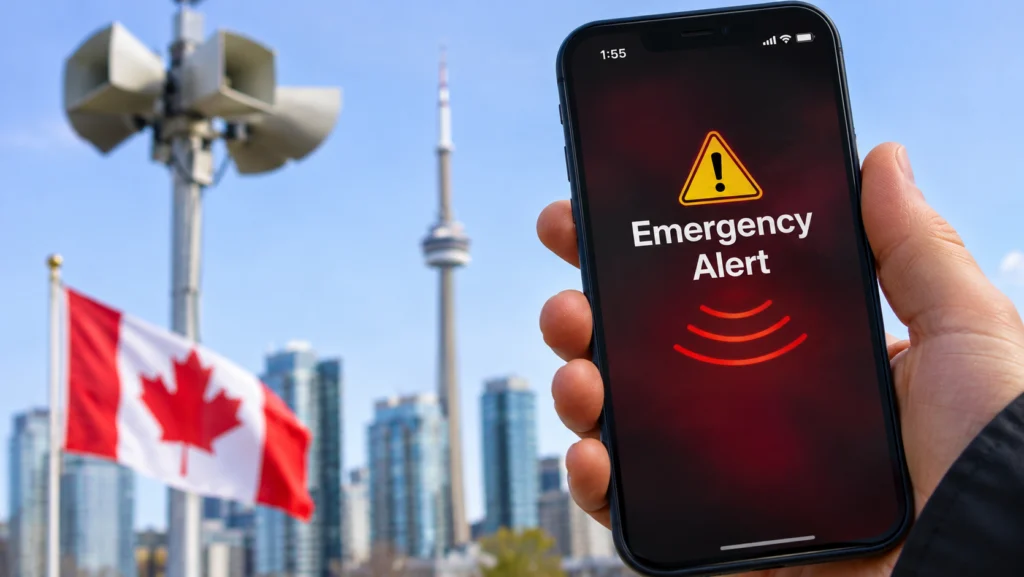
OTTAWA — Canada is preparing to carry out a national test of its emergency early warning system, known as Alert Ready, today, Wednesday. Sound alerts and test messages will be sent to mobile phones, televisions and radios in all provinces and territories.
The test is intended to confirm that the system is ready and able to send warnings to residents during real emergencies, such as floods, tornadoes, wildfires and child abductions.
The agencies overseeing the test stressed that the messages sent today are for testing only and do not indicate any actual danger requiring emergency action.
This is the second test in 2026, as part of the national program, which is usually carried out twice a year, in May and November.
Alert test times in Canadian provinces
Test times differ by province or territory, as the alerts are not sent at the same moment across the country.
The official schedule for Wednesday, November 18, in each region's local time, is as follows:
- Ontario: 12:55 p.m.
- Quebec: 1:55 p.m.
- British Columbia: 1:55 p.m.
- Alberta: 1:55 p.m.
- Manitoba: 1:55 p.m.
- Saskatchewan: 1:55 p.m.
- Nova Scotia: 1:55 p.m.
- New Brunswick: 10:55 a.m.
- Prince Edward Island: 12:55 p.m.
- Newfoundland and Labrador: 9:55 a.m.
- Yukon: 1:55 p.m.
- Northwest Territories: 1:55 p.m.
- Nunavut: 1:55 p.m.
These times are in the local time of each province or territory, so different regions may receive the alert at widely separated hours.
What will happen when the alert arrives?
A compatible mobile phone will emit a distinctive alert sound, along with a message on the screen explaining that the alert is part of a national test.
Similar messages will also be displayed on participating television channels and radio stations, with regular programming temporarily interrupted.
The alert sound may seem loud or sudden, but it does not require anyone to call emergency services or leave their homes.
Residents are asked simply to read the message and become familiar with the look of the alert, so that they can recognize it during a real emergency.
Can the Alert Ready alert be turned off?
The responsible agencies confirmed that users cannot opt out of Alert Ready or disable alerts through the usual subscription options.
Messages are sent to compatible phones connected to 4G LTE or 5G networks.
However, receipt of the alert may be affected by the device model, its compatibility and the quality of the network connection, which means some users may not receive the message.
The system aims to reach as many people as possible in a short time, without the need to download a separate app.
Why does Canada carry out these tests?
Periodic tests help assess the performance of the technical infrastructure and confirm that telecommunications companies and media outlets can deliver messages effectively.
They also give residents a chance to become familiar with the sounds of official warnings, especially those who have never received a real alert.
Federal and provincial government bodies take part in running the system, along with telecommunications companies, media organizations and the technical infrastructure operator Pelmorex.
The system is used to issue warnings about severe weather, floods, fires and other threats that require a rapid response.
More than 1,200 alerts in 2026
Pelmorex said the Alert Ready system has distributed more than 1,215 emergency alert messages across Canada since the beginning of 2026.
These figures underline the importance of having a single, unified way to inform residents of hazards, especially with the growing frequency of extreme weather events.
Authorities are urging Canadians not to be alarmed when they hear the alert today and to treat it as an opportunity to confirm that official messages are getting through.
They also advise following the instructions of local authorities when receiving any real warning in the future, because a quick response can be decisive in protecting lives and property.
More from Hala Canada
- Carney and Trump meet for about 20 minutes in China to discuss trade dispute
- Health Canada recalls four lots of PegLyte bowel preparation powder over possible foreign matter
- Ontario to raise minimum fines for loud vehicle noise offences from $60 to $200
- Rabid bat found in Quebec long-term care home; province works on urgent plan
- Carney says trade talks with China are easier than with the U.S., plans to meet Trump
- Toronto police to announce results of wide-ranging probe into towing-related gang crime