
Carney says trade talks with China are easier than with the U.S., plans to meet Trump
Prime Minister Mark Carney says a trade deal with Washington is harder to reach than understandings with China, and describes Donald Trump's stance on closer ties between Ottawa and Beijing as tariffs continue.
Translated from Arabic. Read the original بالعربية
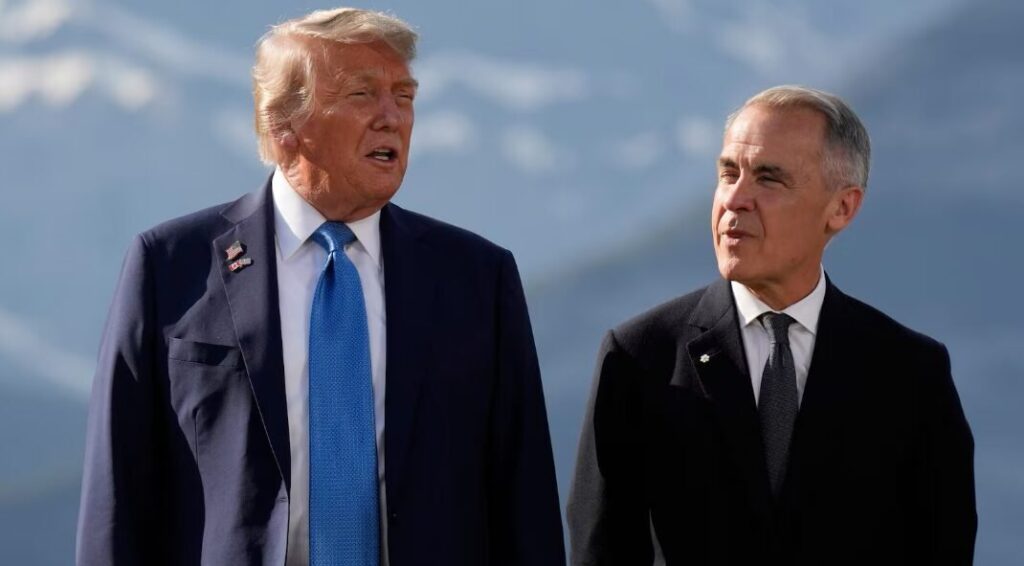
SHENZHEN — Prime Minister Mark Carney said reaching new trade understandings with China has become easier than negotiating with the United States. He explained that the economic relationship between Ottawa and Washington is larger and more complex, particularly after changes made by U.S. President Donald Trump's administration to its trade policies.
Carney made the remarks at a news conference on the sidelines of the Asia-Pacific Economic Cooperation (APEC) summit in the Chinese city of Shenzhen, where Canada is seeking to strengthen its economic presence in Asian markets.
The prime minister said his government is focused on reaching an agreement that protects Canadian interests, rather than accepting terms that could harm sectors of the national economy.
Carney describes Trump's position on closer ties with China
Carney said he does not sense that Trump is greatly bothered by the expansion of trade relations between Canada and China.
He said the U.S. president has shown interest in understanding Ottawa's approach toward Beijing and the sectors in which Canada wants to develop co-operation.
He noted that Canada-China relations do not appear to be among the main issues occupying the U.S. administration at present.
The remarks follow criticism from Trump's trade adviser, Peter Navarro, of the Canadian government over its readiness to expand economic partnerships with China.
Navarro had warned of the risks of growing dependence on Beijing, particularly in sensitive industrial sectors.
New agreements between Canada and China
Carney and Chinese President Xi Jinping announced this week that they had reached understandings to ease trade restrictions on a number of products.
The understandings cover pork, canola, steel and aluminum, following earlier steps to reduce tariffs on electric vehicles and some agricultural products.
Canada is also preparing to send a large trade mission to China in 2027, with the aim of expanding opportunities for Canadian companies.
Carney said his country's exports to China have risen by more than a third this year, while bilateral trade has reached about C$125 billion.
Why are the U.S. negotiations more complex?
The prime minister said the United States has fundamentally changed its trade objectives, which has pushed the negotiations beyond traditional tariffs.
The disagreements include the future of the auto industry, Canada's freedom to conclude agreements with other countries, and the protection of Canadian cultural and language policies.
Formal negotiations stalled last August after the two sides accused each other of adding new demands at the last minute.
Washington responded by imposing tariffs on billions of dollars' worth of Canadian goods, while Ottawa took retaliatory tariff measures against U.S. products.
The trade relationship between the two countries remains one of the largest economic relationships in the world, because of deeply interconnected supply chains and investment.
The auto industry at the heart of the dispute
Carney said Canada could turn to Chinese automakers if the U.S. negotiations fail to protect the domestic sector.
The Canadian auto industry faces growing challenges as a result of U.S. tariffs, particularly in Ontario, which is home to major plants and extensive supplier networks.
However, the prime minister stressed that his country's move toward China focuses mainly on exporting resources and commodities, such as iron and oil, rather than advanced technologies with security sensitivities.
Will Carney meet Trump in China?
Carney said some progress has been made in the trade talks and that he intends to meet Trump during the summit.
He stressed that his government is prepared to take the necessary steps to reach an agreement, on condition that it serves the interests of Canadians.
Ottawa is seeking to strike a balance between preserving its core economic relationship with Washington and diversifying its exports toward Asia and Europe.
The future of the negotiations depends on the two sides' ability to move past their differences over tariffs, investment and trade sovereignty, amid continuing pressure on Canadian businesses and workers.
More from Hala Canada
- Carney and Trump meet for about 20 minutes in China to discuss trade dispute
- Health Canada recalls four lots of PegLyte bowel preparation powder over possible foreign matter
- Ontario to raise minimum fines for loud vehicle noise offences from $60 to $200
- Rabid bat found in Quebec long-term care home; province works on urgent plan
- Canada tests Alert Ready emergency alert system across all provinces today
- Toronto police to announce results of wide-ranging probe into towing-related gang crime