
Could all flights in Canada be halted? Expert explains the key difference with the U.S.
A Canadian aviation expert says a repeat of the U.S. flight shutdown is unlikely in Canada, citing more advanced air traffic systems and $3.5 billion in investment.
Translated from Arabic. Read the original بالعربية
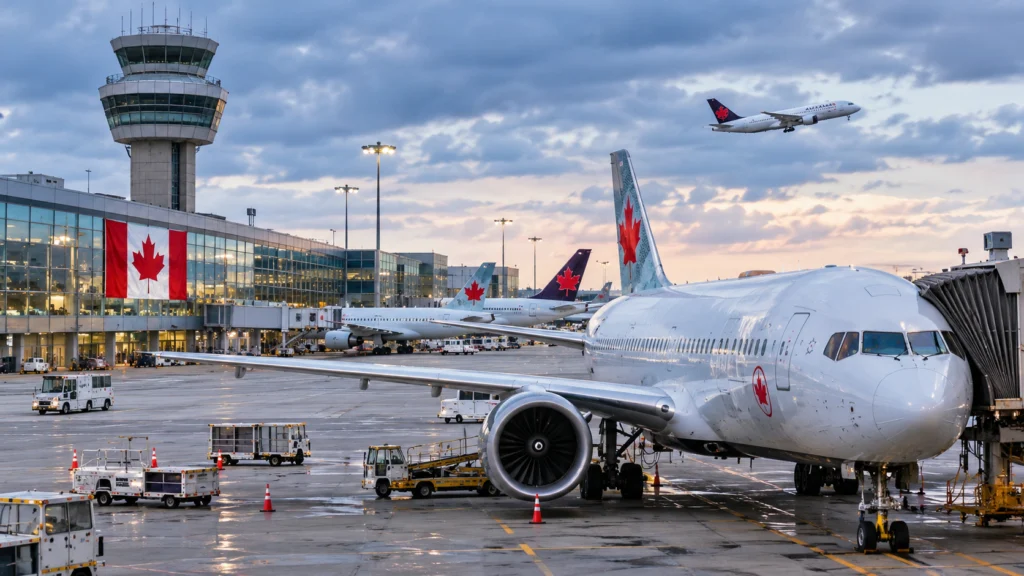
OTTAWA — A Canadian aviation management expert says the likelihood of a nationwide halt to flights in Canada, like the crisis in the United States last Friday, remains low because the country has more advanced and resilient air traffic control systems.
John Gradek, a lecturer in aviation management and supply chains at McGill University, said Canadian infrastructure is more modern than its American counterpart and relies on a different funding model that makes it less exposed to political disputes.
His comments followed an exceptional order issued by the U.S. Federal Aviation Administration on Nov. 13, which stopped aircraft departures across the country because of disruptions to communications and air traffic control systems.
Although the effects of the crisis reached Canadian airports, NAV Canada, the company responsible for air navigation, said its systems were not affected by the U.S. outage.
Expert: Canada has a more advanced system than the U.S.
Gradek believes the United States needs to learn from Canada's experience in managing air traffic.
He said Canada's air traffic control systems are stronger and more up to date than those run by the U.S. Federal Aviation Administration (FAA).
He noted that the U.S. crisis exposed serious weaknesses in infrastructure, particularly reliance on aging equipment whose failure can lead to widespread disruption.
He criticized the fragility of systems that allow a technical problem in one part of the network to bring air traffic to a halt nationwide.
According to the expert, the Canadian model shows the importance of upgrading equipment and having stable sources of funding, away from short-term political decisions.
What caused the U.S. shutdown?
The crisis began on Friday, when the FAA ordered a halt to departures after communications problems affected about 22 air traffic control centres.
The agency said on Sunday that its investigation is focused on a radar site in Amarillo, Texas, and a radio communications site in El Dorado, Arkansas.
Preliminary information indicates the problem was linked to an abnormal surge of data flowing through the system, which caused intermittent disruptions to communications and radar information.
U.S. Transportation Secretary Sean Duffy said the fault appeared after a contractor replaced old copper wiring with fibre-optic cables at the Arkansas site.
He added that the problem later spread to the Texas site before its effects widened within the air traffic control network.
However, authorities have not yet announced a final technical cause, and the investigation is continuing.
Why does Canada's aviation system differ from the American one?
One of the main differences between the two countries is how air navigation services are managed and funded.
In the United States, the FAA, a government agency, runs the air traffic control system and relies on government funding.
In Canada, NAV Canada, a private non-profit corporation, operates civil air navigation services.
The organization relies on navigation service charges paid by airlines and aircraft operators, rather than directly depending on annual federal budget allocations.
Gradek believes this model provides more stable funding and helps carry out long-term modernization plans without being directly affected by political disputes.
It also allows the company to develop infrastructure according to the needs of the aviation sector and safety requirements.
$3.5 billion in investments to strengthen aviation safety
NAV Canada said it has invested about $3.5 billion in air traffic management systems and related infrastructure.
Company spokesperson Mariam Amini said the Canadian systems include multiple levels of protection and redundancy.
These measures include backup systems and contingency plans, along with regular training for staff to deal with possible failures.
The measures are intended to ensure air navigation operations continue safely even when some technical components fail.
Amini said the company's systems were not affected by the U.S. crisis and that air traffic control services in Canadian airspace continued to operate normally.
Canadian airports affected despite sound local systems
Although Canada's control systems did not suffer a fault, the effects of the U.S. crisis spread to several of the country's largest airports.
Flights to and from the United States were suspended, including flights linked to Toronto Pearson and Montréal-Trudeau airports.
Air Canada also announced it was cancelling the rest of its flights to the United States on Friday.
Other airports, including Vancouver, Calgary and Edmonton, saw disruptions and delays linked to U.S. air traffic.
The U.S. ground stop was lifted on Friday evening, but airlines warned that delays and cancellations could continue for several days because aircraft and crews need to be repositioned.
Canadian authorities said domestic flights were not affected by any direct fault in Canada's air navigation systems.
U.S. transportation secretary acknowledges funding problem
The outage again drew attention to the aging of U.S. air traffic control infrastructure.
Transportation Secretary Sean Duffy said the system has suffered from underinvestment for decades, adding that responsibility does not lie with a single political party.
He added that successive U.S. administrations did not allocate enough funding to modernize equipment and networks.
He called on Congress to provide billions of dollars in additional funding to upgrade the air navigation system, in order to reduce the chances of a repeat.
Gradek believes reliance on intermittent government funding has contributed to delays in modernizing U.S. systems compared with Canada.
Is a similar crisis in Canada impossible?
Although the expert praised the Canadian system, a lower likelihood of a nationwide flight halt does not mean technical failures are impossible.
Any complex air traffic management network can face problems with communications, equipment or operating systems.
However, backup equipment, emergency procedures and ongoing upgrades can reduce the chance that a limited fault turns into a national crisis.
NAV Canada's statements indicate that the Canadian aviation system is designed to handle technical problems while maintaining air traffic safety.
Even so, the system's ability to contain any fault depends on its nature, its scale and the systems affected.
What does this mean for travellers in Canada?
The statements offer travellers some reassurance about the safety of air traffic control systems within Canada.
But the close links between Canadian and U.S. airports mean that any major disruption in the United States can quickly affect international flights.
Travellers with flights to the United States or through its airspace are therefore advised to follow airline updates and check their flight status before heading to the airport.
More from Hala Canada
- Toronto ranks 20th in Oxford Economics index of world's top 1,000 cities, first in Canada
- Quebec premier calls first meeting with Carney 'pleasant' after weeks of political tension
- A Canadian grandparent may make you a citizen and put your permanent residence application on hold
- Two Soup Time soups recalled in Canada over undeclared wheat
- Poll: Most Canadians oppose a U.S. trade deal that keeps tariffs on Canadian goods
- Carney announces up to $560 million to protect tropical forests worldwide