
Halifax security forum chair warns world can no longer rely on U.S. leadership
Peter Van Praagh, president of the Halifax International Security Forum, said the United States is no longer a predictable leader and urged democracies to strengthen co-operation on global security challenges.
Translated from Arabic. Read the original بالعربية
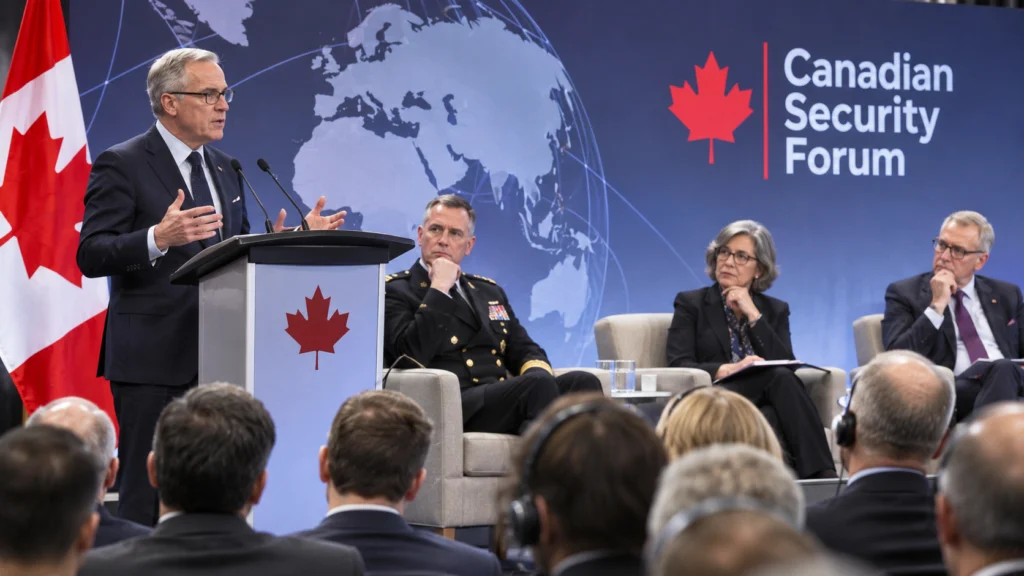
HALIFAX — Peter Van Praagh, president of the Halifax International Security Forum, warned that the United States can no longer be counted on as a leader whose policies are predictable in the democratic world.
Van Praagh called on other countries to take on greater responsibility in addressing international challenges, amid tensions that U.S. President Donald Trump's policies have caused within Western alliances.
His remarks came on Friday at the opening of the forum's 18th edition in Halifax, Nova Scotia.
Call for new international leadership
Van Praagh said the changes in U.S. foreign policy are pushing governments and international institutions to look for new approaches to ensure global stability.
He said no single country is able to replace the political, economic and military weight of the United States.
However, he stressed that the responsibility for defending democratic principles and maintaining international security rests with all the countries concerned and should not be left to Washington alone.
His remarks reflect growing concern about the future of the traditional alliances formed over past decades.
About 300 international figures taking part
Halifax is hosting the international security forum from Nov. 20 to 22, with about 300 political, military, diplomatic and academic figures taking part.
Canada's Minister of National Defence, David McGuinty, is co-hosting the event with forum president Peter Van Praagh.
A number of senior Canadian officials are also attending, including Chief of the Defence Staff Gen. Jennie Carignan, Deputy Minister of National Defence Christiane Fox and Canadian Coast Guard Commissioner Kevin Brosseau.
The forum offers an opportunity to discuss shared security challenges and develop strategic co-operation among democratic countries.
Defence minister calls for moving beyond traditional frameworks
Defence Minister David McGuinty said the international order is going through a fundamental shift that requires a review of how allies co-operate.
He noted the importance of the role the North Atlantic Treaty Organization (NATO) has played in ensuring collective security, adding that traditional institutions cannot be the only means of co-operation in the future.
The remarks are in line with the approach of Prime Minister Mark Carney, who has called for diversifying international partnerships and strengthening the independence of Canada's decision-making.
They also reflect Ottawa's desire to develop its defence relationships with other partners without abandoning its commitments within existing alliances.
Pentagon officials absent from the forum
This year's edition is taking place without U.S. military officials from the Department of Defense, because of restrictions the Trump administration imposed in 2025 on taking part in think-tank events.
Previous U.S. administrations, both Republican and Democratic, sent senior military officials to the forum.
Despite the absence of Pentagon representatives, a bipartisan delegation from the U.S. Congress, including Republicans and Democrats, is taking part in the Halifax meetings.
Democratic Senator Chris Coons criticized Trump's appearance alongside Chinese President Xi Jinping and Russian President Vladimir Putin during the recent summit in China.
Coons said the scene reflects a decline in the United States' leadership standing on the international stage.
Trump renews criticism of Canada
As the forum got under way, the U.S. president renewed his criticism of Canada in remarks at the White House on Friday.
The comments followed his meeting with Prime Minister Mark Carney in China, on the sidelines of an international summit held this week.
Trump said Canadians have become bolder in their dealings with Washington.
Relations between the two countries have grown increasingly tense because of U.S. tariffs, as well as Trump's repeated comments about making Canada the 51st U.S. state.
For its part, the Carney government is working to strengthen economic and political relations with Europe, China and other international partners in order to reduce its reliance on the United States.
Ukraine and artificial intelligence among main issues
This year's Halifax forum agenda includes a wide range of security and geopolitical issues.
Discussions cover the Russia-Ukraine war, the future of NATO, Arctic security, developments in the Middle East and global food security.
Participants are also discussing the opportunities and risks linked to the development of artificial intelligence technologies and their use in defence and military fields.
Organizers set aside a session to discuss Canada's 2026 Defence Industrial Strategy and ways to achieve its goals for developing national capabilities.
The forum comes at a sensitive time for Canada, which is seeking to protect its economic and security interests and maintain its historic ties with Washington while building more diverse international partnerships.
More from Hala Canada
- Alberta issues 374 new invitations to workers under its immigration program
- Leaders and experts from more than 70 countries gather in Halifax for global security forum
- Canada to issue November CPP payments early, with maximum monthly benefit of $1,507.65
- 148 people fall ill with unidentified illness aboard Caribbean Princess cruise ship
- Measles returns to the Americas, with warnings of a serious health setback
- Cadbury chocolate recalled across Canada over undeclared pistachios