
94.2% of Ontario education workers back strike mandate as talks near
Education workers represented by CUPE in Ontario voted 94.2 per cent in favour of strike action if needed, amid disputes over wages, staffing and school funding ahead of bargaining on Nov. 30.
Translated from Arabic. Read the original بالعربية
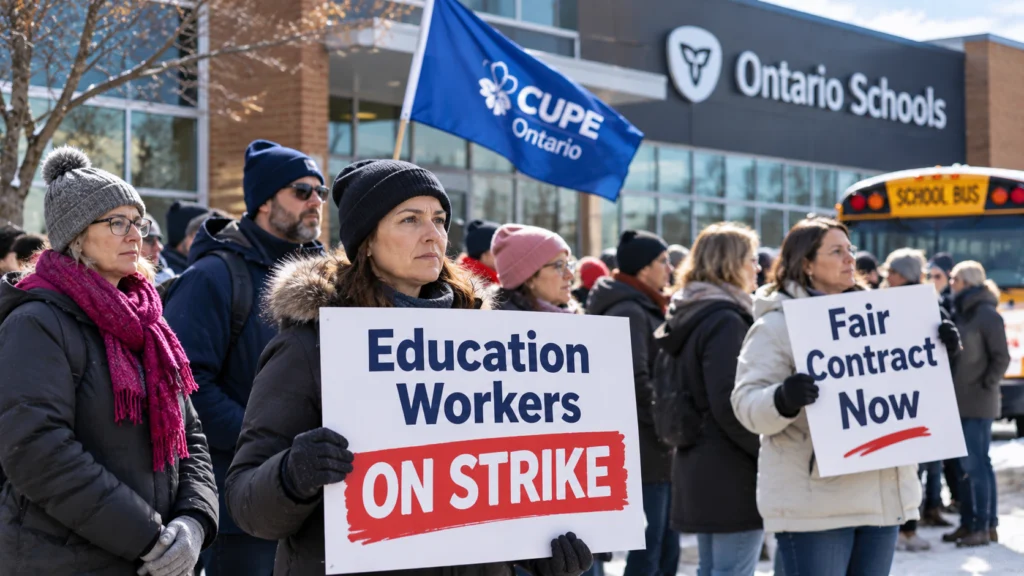
TORONTO — Education workers represented by the Canadian Union of Public Employees (CUPE) in Ontario voted overwhelmingly to give their union a mandate to take strike action if necessary, ahead of the resumption of negotiations with the provincial government and school board representatives.
The Ontario School Boards Council of Unions (OSBCU) announced the results of the vote on Thursday evening, saying support reached 94.2 per cent.
The announcement comes amid disputes over public school funding, staffing levels, wages and working conditions.
High turnout in the vote
Union data show that 52,901 members took part in the vote, out of 68,239 members, a turnout of 77.5 per cent.
The number of participants exceeded the number recorded in the union vote that preceded the confrontation with Doug Ford's government in 2022.
The council represents several categories of workers in educational institutions, including educational assistants, early childhood educators, custodians, school and library secretaries.
It also includes maintenance and information technology staff and workers in child and youth support services.
These jobs differ from those of teachers, although they are directly tied to schools' ability to deliver daily services to students.
Demands for better working conditions
Joe Tigani, president of the council of unions, said the result reflects workers' dissatisfaction with the growing pressures inside educational institutions.
The union's demands include increasing staffing levels, improving wages and benefits, and strengthening job security.
Recent membership data indicate that about 20,000 employees or more work on a temporary or as-needed basis.
The union says that growing reliance on these positions, alongside limited growth in permanent jobs, affects workers' stability and schools' ability to provide regular support to students.
Report points to staff shortages
A recent union report was based on a comparison of staffing and school enrolment data between the 2018-2019 and 2025-2026 school years.
It showed a decline in the ratio of staff to students in at least one job category in all 72 school boards.
Sixty boards recorded a decline in four or more job categories.
The report also pointed to the loss of 642 full-time equivalent positions in early childhood education.
The unions are calling for funding to hire more workers, to provide an early childhood educator and an educational assistant in every kindergarten class, and to cap class sizes at 26 children.
These demands remain bargaining proposals and are not measures approved by the provincial government.
Date of next negotiations
Union representatives are scheduled to meet with the provincial government and school boards on Nov. 30 to present their bargaining proposals.
The meeting follows delays in talks caused by disagreements over which issues should be negotiated centrally and which should be discussed at the local level.
The negotiations are an opportunity to reach a new collective agreement before any action that could affect the regular school schedule.
Four other education unions back strike action
Four other major education unions in Ontario announced this week that they had obtained similar mandates.
Support reached 98 per cent in the Ontario English Catholic Teachers' Association and 97 per cent in the Elementary Teachers' Federation of Ontario.
In the vote held by the Ontario Secondary School Teachers' Federation, 96 per cent of participating teachers backed a strike mandate, compared with 92 per cent of the education workers represented by the same federation.
The union representing French-language teachers recorded 96 per cent support among the permanent and occasional teachers who took part.
Will schools close soon?
Ontario Education Minister Paul Calandra said a strike is not imminent, noting that additional legal steps must be completed before any work stoppage.
He expressed confidence that an agreement can be reached, saying the time available for negotiations allows disruption to classes to be avoided.
CambridgeToday.ca
The union vote does not set a strike date or announce school closures. It gives union leaders a mandate to act if needed and once the legal conditions are met.
For families, following official announcements from school boards remains necessary to learn of any possible changes to services or school schedules.
In its statement on the results, the council of unions did not announce a date for a strike to begin, which makes the upcoming negotiations the key point in determining the course of the dispute.
More from Hala Canada
- As Trump draws closer to China and Russia, Canada and Japan move to build new partnerships
- Labour board sides with employee who said God told him not to get COVID-19 vaccine
- Canada raises required wages for temporary foreign workers in 414 occupations
- York police recover 37 stolen trucks and trailers worth $3.6 million in Brampton
- Former Ontario minister Jill Dunlop declines to answer questions on student aid fraud concerns
- Ontario Liberals to choose new leader Saturday in four-way race