
Hundreds of candidates run for school board trustee seats in Ontario
The Oct. 26 vote takes place while eight boards are under provincial supervision, and it is unclear when elected trustees will be able to exercise their powers.
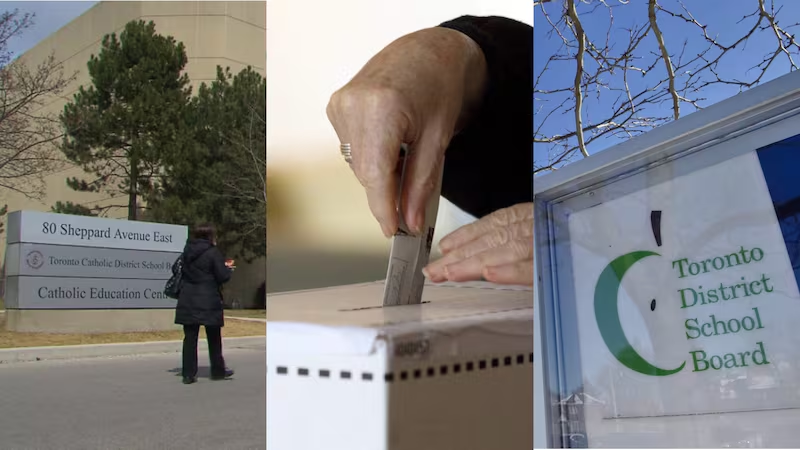
TORONTO — Hundreds of candidates are running for school board trustee seats in Ontario, even though their role may remain limited in scope for an unknown period.
The vote comes as eight school boards are under provincial supervision over concerns about financial management, governance and budget deficits.
The boards under supervision include the Toronto District School Board (TDSB), the Toronto Catholic District School Board (TCDSB), the Peel District School Board, the York Catholic District School Board, the Dufferin-Peel Catholic District School Board, the Ottawa-Carleton District School Board, the Thames Valley District School Board and the Near North District School Board.
The boards are currently run by supervisors appointed by the province, amid allegations of financial mismanagement, accumulated deficits, internal disputes and governance failures.
Under the current arrangement, trustees at the affected boards cannot use board email or telephone systems. They are also not permitted to attend board meetings or to communicate officially with parents and guardians as board representatives.
Uncertainty over when elected trustees will take up their duties
The election comes under an amended Education Act in Ontario, which provides that trustees elected on Oct. 26 will not be sworn in until provincial supervision of their boards ends.
Under the amendment, only the Minister of Education or the appointed supervisor can call the first meeting of an elected board. That differs from the usual process, in which new trustees are sworn in shortly after an election.
The provincial government has not yet set a clear timeline for lifting supervision at any of the eight boards. That raises questions about how long elected trustees will be unable to exercise their official powers.
Despite the restrictions, several candidates say running still has meaning. They note that representing families, students and local communities is not limited to voting in meeting rooms. It also includes hearing complaints, following decisions, demanding transparency and defending the quality of public education.
Candidates stress the importance of democratic representation
Sahirla Othman, one of the candidates, said her decision to run stems from her belief in the importance of public education. She said she sees no reason to stop caring about school issues even while trustees' powers are limited.
She added that giving the Minister of Education the authority to decide when elected trustees' terms begin raises questions about democratic representation, because voters choose their representatives to defend their communities and speak for their children.
Othman said she will keep working for students and families, even with the restrictions placed on trustees' official role.
Candidate Anu Sriskandarajah described the decision to run during a period of provincial supervision as "an act of preserving democracy." She said public schools belong to the communities they serve, and that parents, teachers and residents should have a voice in decisions about them.
She added that the role of a trustee on a board under supervision should go beyond routine administrative oversight to include demanding transparency and fairness.
Andrew Waters said provincial supervision has created uncertainty about when elected trustees will be able to carry out their responsibilities, but has not removed the need for local representation. He said he will continue to support parent councils and school communities, regardless of when trustees are allowed to return to their seats.
He stressed that a commitment to public education does not begin with winning elected office and does not end when a term ends. He added that suspending trustees' powers should not silence the communities that elected them.
Differing views on trustees' role and limits
Candidates differ on the kind of role they can play during supervision. Tim Ellis said the crisis has strengthened his determination to keep defending public education, and that losing legal powers does not stop residents from organizing and working for change.
Matthew Zavino said trustees can fill several roles even without formal authority, because elected office gives its holder a platform to connect with the community.
Sarah Smithies said current conditions make running more important, arguing that public education faces challenges related to democratic representation and funding. She said trustees may need to work both inside and outside the system to defend students, families and teachers.
Carey Debas said he does not consider trustees entirely powerless, noting that being elected gives him a mandate to speak for residents of his ward even before he is sworn in. He added that he is ready to speak to the media and to call for authority to be returned to local communities.
Sara Concordia agreed, saying limited powers do not remove trustees' responsibility to the families who elected them. Karen Emerson said trustees may lose their formal authority, but they do not lose their voices, their responsibilities or their ability to mobilize communities.
Jared Kolb said the role of trustees may become more important during supervision, because decisions made in this period will affect schools for years to come. He said that, if elected, he would work with other trustees to organize regular public meetings to discuss issues of concern to parents, students, teachers and administrators.
Axel Arvizu said the election gives residents a chance to choose their representatives and demand accountability. He said a trustee's responsibilities include listening to families, advocating for students with special needs, supporting academic achievement, strengthening school safety and ensuring public money is spent responsibly.
Ontario government defends supervision
For its part, Emma Testani, a spokesperson for Ontario Education Minister Paul Calandra, said the government believes holding school boards accountable does not prevent trustees from representing parents and their communities.
She added that the new legislation, known as the Putting Student Achievement First Act, aims to ensure board resources are spent on student success. It does so by limiting unnecessary trustee expenses, strengthening financial oversight, bringing in qualified professional leadership and putting safeguards in place to prevent administrative failures that could threaten services to students.
She said the boards in question were placed under supervision because of serious concerns about financial mismanagement and governance, and that these cases highlight the need for stronger accountability to protect public funds and students.
Testani said putting student achievement first does not conflict with measures meant to protect public money, improve decision-making and strengthen boards' ability to serve their communities.
Trustees' role reduced under the new legislation
Tasha Khairuddin is calling on the province to return control of the Toronto District School Board to elected trustees as soon as possible.
She said schools face challenges including violence and bullying in classrooms, some students struggling with basic reading and math skills, and ageing school buildings.
She said she visited 30 schools during the campaign and noticed parents' frustration over how hard it is to make their voices heard on these problems.
She stressed that trustees should be community advocates, monitors of decisions and contributors to solving problems.
Rosanna Araujo also said trustees' role should not be limited to making decisions, but should include working with parents, teachers, municipal councillors, MPPs and community organizations.
Under the Putting Student Achievement First Act, which was passed and came into force on May 7, trustees will continue to sit on Ontario school boards, but their responsibilities will be reduced. Each board will be limited to a maximum of 12 trustees.
English-language school boards will also be run by a chief executive officer who handles budgets and negotiations, and a chief education officer who oversees student achievement.
The change also reduces trustees' discretionary expenses and sets an annual cap of $10,000 on their pay.
Calandra said in the spring that trustees will not return to exercising their powers until supervisors are able to put the boards back on the right track. That includes balanced budgets, rebuilt reserves and restored community trust.
While the date supervision will end remains unknown, candidates insist the election will determine who represents local communities when elected governance returns. They say the current restrictions will not stop them from staying in touch with families and defending public education.
More Elections

Latest from Hala Canada
- Canada gives provinces 139 days to nominate tens of thousands of workers for permanent residence
- Newfoundland and Labrador issues 98 new immigration invitations in Nov. 19 round
- Trump administration weighs targeting Iranian leaders to end war, with divisions in Washington over risks
- Report: 82% of Canadian grandparents give financial help to children and grandchildren
- Former London, Ont., councillor Mariam Hamou sentenced to probation in case involving mayor
- Canada to pay $5,000 bonuses to eligible trades workers: eligibility and how to apply