
Canada's exports to China reach record levels ahead of Prime Minister Carney's visit
Third-quarter data show a jump in crude oil and agricultural exports, with Alberta and Saskatchewan accounting for about 78 per cent of the increase.
Translated from Arabic. Read the original بالعربية
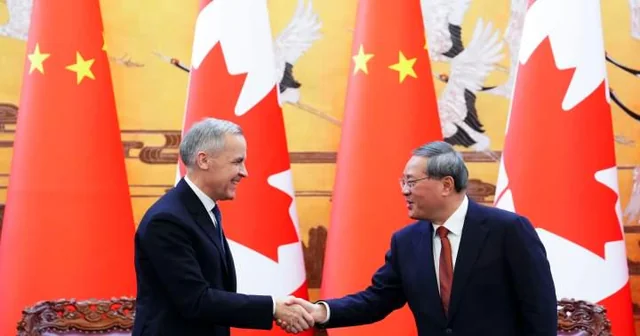
OTTAWA — New trade data indicate that Canadian exports to China are reaching unprecedented levels, particularly in western Canada, just before Prime Minister Mark Carney travels to China to meet Chinese President Xi Jinping next week.
The figures are based on third-quarter data compiled by the China Institute at the University of Alberta, and show strong export growth led by food and energy shipments.
The institute's director, Philippe Rheault, said: "Our exports will hit record levels this year, and the numbers are accelerating."
Highest quarterly level on record
Two-way trade between the two countries totalled $36.78 billion in the third quarter, the highest quarterly level on record. Most of that is due to energy exports.
Crude oil exports to China jumped 159 per cent, averaging 327,000 barrels a day. The increase is attributed in large part to the additional capacity provided by the Trans Mountain pipeline.
Rheault noted that many experts had expected most Canadian oil reaching marine ports to go to California rather than Asia. He said: "That expectation has clearly been proven wrong. The oil is going almost entirely to East Asia, and most of it to China."
Supply disruptions in the Middle East also contributed to higher prices for oil exported to China and the United States.
Rise in agricultural exports
The figures also point to China easing tariffs on Canadian agricultural products:
- Canola meal exports rose to $360.3 million, compared with $12.9 million a year earlier.
- Pea exports rose to $147.6 million, compared with $9.2 million.
- Beef exports reached $181.4 million, after being nearly nil a year earlier.
Most provinces recorded higher exports to China in the same quarter, but Alberta and Saskatchewan accounted for about 78 per cent of the total increase. According to the report, Canadian domestic exports to China rose by about $4.32 billion year over year. Alberta's jump came mainly from crude oil, while Saskatchewan's came from canola meal, canola seed, potash and peas.
A shift after years of tension
The growth marks a sharp turnaround from the low point in Canada-China relations, after Canadians Michael Kovrig and Michael Spavor were detained in China following the arrest of Huawei executive Meng Wanzhou in Vancouver in 2018.
Trade rebounded after an agreement reached last January, under which Ottawa secured lower Chinese tariffs on Canadian goods in exchange for allowing Chinese electric vehicles into the Canadian market.
Rheault said the figures reflect the effect of Canada's return to engagement with China and a change in federal policy. He added: "I think some observers will remain surprised at how far the prime minister and his government have gone in engaging with China, at a time when the United States may be reconsidering its approach to Canada."
Warnings about reliance on a single market
Some experts have warned that increased trade with China carries risks that Canadian producers know well. Vina Nadjibulla, chief executive of the Centre for Strategic Statecraft, said: "In 2024, about 70 per cent of our canola seed exports went to China, which gave Beijing significant leverage that it used during political disputes."
She added: "We need to expand trade with China while continuing to develop other markets. The goal is to reduce strategic dependence, not simply shift it from one major power to another."
Despite the rise in exports to China, Canada still exports about ten times as much to the United States as it does to China. Carney is seeking to double Canadian exports of goods and services to non-U.S. markets by 2035.
Asian tour
Carney leaves Wednesday on a quick tour of Asia that includes the Association of Southeast Asian Nations (ASEAN) summit in the Philippines, the Asia-Pacific Economic Cooperation (APEC) summit in China, where he is expected to meet Xi, and the Francophonie summit in Cambodia. It will be Carney's second visit to China as prime minister, and comes as trade between the two countries is at unprecedented levels.
More from Hala Canada
- Ontario outlines tighter OSAP rules after widespread irregularities found at private colleges
- Montreal police arrest about 15 in jewellery theft crackdown; teens as young as 13 recruited
- Ticket sold in Mississauga wins $38-million Lotto 6/49 Gold Ball jackpot
- Canada proposes extending ban on foreign home purchases to 2029: what it means
- Toronto police identify suspect, 19, in fatal Etobicoke shooting of 18-year-old
- Urgent Toronto meeting on Brampton Stellantis plant, where more than 2,000 jobs are at stake