
Canadian exports to China up 41% this year as Carney prepares China visit
Canadian goods exports to China have risen 41 per cent since the start of 2026, as Prime Minister Mark Carney prepares a new trip to China to expand trade and diversify markets away from the United States.
Translated from Arabic. Read the original بالعربية
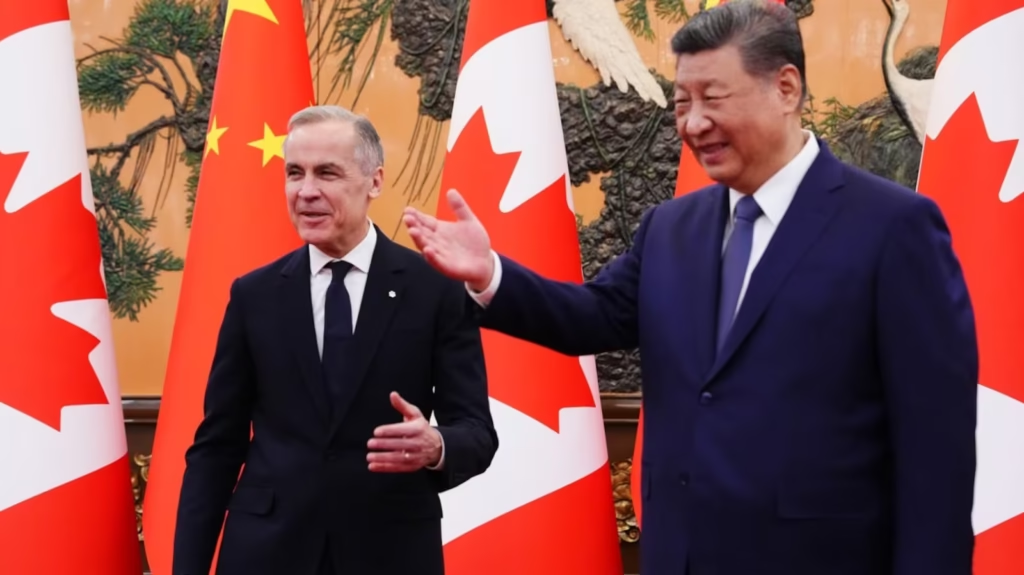
OTTAWA — Canadian exports to China rose sharply in the first nine months of 2026, a sign of improving economic relations between the two countries. The increase comes as Prime Minister Mark Carney prepares to visit China as part of an international tour that begins Wednesday, Nov. 11.
Figures released Monday by the Department of Finance Canada show that goods exports to China rose 41 per cent since the start of the year, compared with the same period in 2025.
The jump follows a series of trade understandings between Ottawa and Beijing, as Canada seeks to diversify its foreign markets and reduce its reliance on the United States, which remains the main destination for Canadian exports.
Exports to China show notable growth
Statistics Canada data indicate that the value of goods exports to China reached about C$4.4 billion in September alone, up three per cent from the previous month.
Compared with September 2025, the increase was about 67.3 per cent, or roughly $1.8 billion.
Canadian imports from China, by contrast, fell five per cent in September to about $5.9 billion.
As a result, the monthly trade deficit with China narrowed to about $1.5 billion, compared with $2 billion in September of last year.
The rise in exports does not mean the trade deficit has ended, since Canada still imports more goods from China than it exports to it.
Energy and minerals drive growth
Energy and mineral products were among the main drivers of export growth during the year.
An analysis by the China Institute at the University of Alberta found that energy exports to China rose 67.1 per cent in the first quarter, reaching $3.38 billion.
Exports of mineral ores and non-metallic minerals also increased, by 60.2 per cent, to about $2.37 billion over the same period.
The figures show the growing role of natural resources in trade between the two countries, as Chinese demand for energy and raw materials continues.
New Carney visit to China
The Prime Minister's Office announced that Carney will travel abroad from Nov. 11 to 19, with stops in Ireland, the Philippines, Cambodia and China.
He is scheduled to take part in the Asia-Pacific Economic Cooperation (APEC) summit in Shenzhen, China, after an official visit to Beijing last January.
The tour aims to expand trade partnerships, attract investment and strengthen the presence of Canadian companies in Asian markets.
The government said the new strategic partnership with China opens additional trade opportunities worth more than $7 billion.
Ottawa aims to increase its exports to the Chinese market by 50 per cent by 2030, compared with 2025 levels.
Agricultural agreements open new markets
Easing of Chinese trade restrictions has improved export prospects for Canadian agricultural products.
Since March 2026, Beijing has lowered the tariff on Canadian canola seed to 14.9 per cent, from nearly 85 per cent.
It has also suspended additional tariffs on products including canola meal, peas, lobster and crab until the end of the year.
The Canadian government says the new measures are helping farmers and seafood exporters regain their share of the Chinese market.
However, whether these gains last depends on stable bilateral relations and on trade restrictions not returning.
High-level economic talks in Vancouver
Carney's visit was preceded by an economic meeting in Vancouver on Nov. 9 between Chinese Vice Premier He Lifeng, Canadian Finance Minister François-Philippe Champagne and International Trade Minister Maninder Sidhu.
The officials discussed boosting investment, financial co-operation and expanding trade.
Total goods trade between the two countries reached $125.7 billion in 2025, including $35 billion in Canadian exports and $90.6 billion in imports from China.
China remains Canada's second-largest single trading partner after the United States.
Will Canada's dependence on the U.S. market ease?
Despite the strong growth in exports to China, the United States remains the most important market for Canadian products, which makes diversifying partners a gradual process.
Carney's government hopes Asian markets will provide additional opportunities for Canadian companies and workers, particularly in the energy, agriculture and technology sectors.
More from Hala Canada
- Young man sentenced to 5½ years in prison for shooting at Montreal Jewish school
- Budget 2026 omits pledge to double home building as Ottawa sets new non-market housing target
- Dunkin' returns to Canada after eight years; building permits reveal Toronto location
- Poll: most Toronto-area residents say their communities offer enough support to newcomers
- Toronto traveller faces possible 15-year prison term in Albania over baggage tag case
- China says it has no interest in interfering in Canada's affairs ahead of Carney-Xi meeting