
China says it has no interest in interfering in Canada's affairs ahead of Carney-Xi meeting
China denies interfering in Canada's internal affairs ahead of a meeting between Mark Carney and Xi Jinping on Nov. 18 and 19, amid security disputes and efforts to strengthen trade ties.
Translated from Arabic. Read the original بالعربية
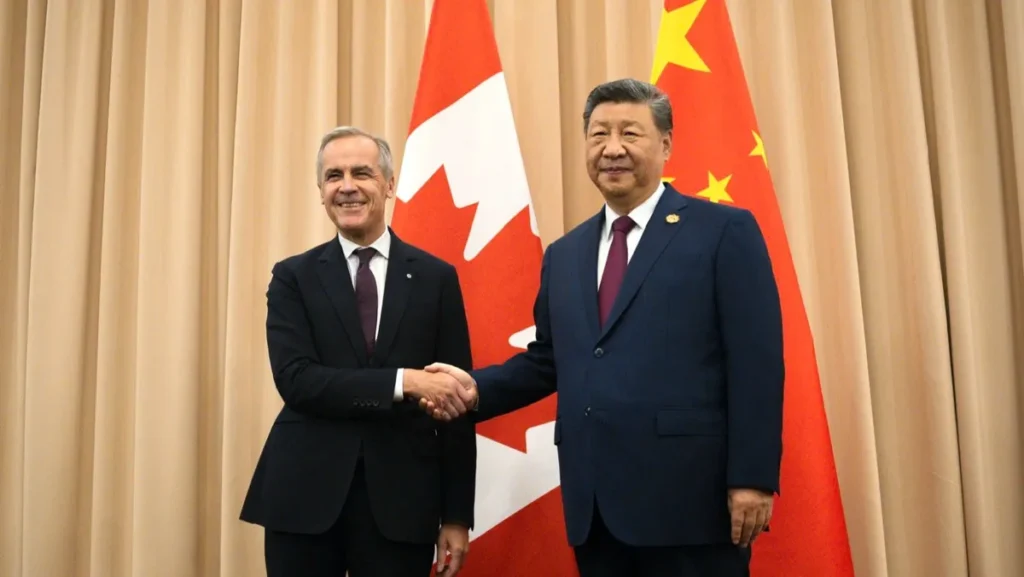
OTTAWA — China has denied wanting to interfere in Canada's internal affairs, responding to comments by Prime Minister Mark Carney that he will raise the issue of foreign interference at his upcoming meeting with Chinese President Xi Jinping. The two countries are seeking to expand their economic relations after years of tension.
China's response came on Wednesday, ahead of the leaders' meeting on the sidelines of the Asia-Pacific Economic Cooperation (APEC) summit, scheduled for Nov. 18 and 19 in Shenzhen, China.
Beijing denies interfering in Canadian affairs
Chinese Foreign Ministry spokesperson Guo Jiakun said at a regular news conference that his country adheres to the principle of non-interference in the internal affairs of other countries. He said China has no interest in interfering in Canada's affairs.
The statement came a day after Carney announced he would raise the issue directly with Xi, along with international security and the trade partnership. The difference between the two positions reflects an ongoing disagreement over security allegations, despite the diplomatic rapprochement that has begun between Beijing and Ottawa.
Carney intends to discuss the issue candidly
Carney spoke to reporters in Montreal on Tuesday, Nov. 10, saying that direct meetings give leaders an opportunity to raise sensitive issues clearly and frankly.
He stressed that Canada considers it a core priority that China or any other country not interfere in its internal affairs. He added that the growing economic partnership with Beijing is based on clear guardrails that define the areas where cooperation is possible.
The prime minister did not announce any new measures against China. Nor did he say the upcoming meeting would be limited to the security dispute; he said it would also address the global security situation and opportunities for economic cooperation.
Earlier Canadian allegations of election interference
The roots of the dispute go back to allegations by Canadian security agencies that China attempted to influence Canada's political environment and democratic institutions.
In January 2025, a public inquiry into foreign interference concluded that China was the most prominent foreign actor targeting Canada's democratic institutions, and it identified attempts to interfere in previous federal elections.
Concerns were also raised about pressure on members of the Chinese community in Canada, particularly activists from Hong Kong, as well as threats related to cybersecurity.
Beijing, however, consistently denies these allegations and says it respects the sovereignty of states. It is important to distinguish between the findings announced by Canadian inquiries and China's official position rejecting them.
A new economic partnership despite disagreements
Bilateral relations have improved since Carney's visit to Beijing in January 2026, the first visit to China by a Canadian prime minister since 2017.
During that visit, the two sides announced a strategic partnership covering energy, agriculture, trade and public safety, along with multilateral cooperation and cultural exchange.
Understandings were also reached to ease some trade barriers on Canadian agricultural products, after disputes that affected exports in past years.
According to the Prime Minister's Office, the new partnership also includes cooperation on clean energy and the development of investment opportunities, with an emphasis that the goal is to build an economy better able to withstand global disruption.
In the same context, Carney said his government has chosen a new ambassador to China, whose name will be announced soon. The post has been vacant since the spring.
The rapprochement is linked to Ottawa's desire to diversify its trading partners and reduce its economy's dependence on the American market, without setting aside national security considerations.
What lies ahead for Canada-China relations
The upcoming Shenzhen meeting is a test of the two sides' ability to combine expanded trade with discussion of contentious issues. The Canadian government wants to benefit from opportunities in the Chinese market, but it also faces domestic demands to protect democratic institutions and communities living in the country.
For its part, Beijing is seeking to consolidate the new path of rapprochement and says its relations with Canada should be based on mutual respect.
So far, no new agreement on foreign interference has been announced, and China's statements alone cannot be considered a resolution of the dispute. The nature of any possible understandings will become clear after Carney and Xi meet on Nov. 18 and 19.
More from Hala Canada
- Young man sentenced to 5½ years in prison for shooting at Montreal Jewish school
- Budget 2026 omits pledge to double home building as Ottawa sets new non-market housing target
- Dunkin' returns to Canada after eight years; building permits reveal Toronto location
- Poll: most Toronto-area residents say their communities offer enough support to newcomers
- Toronto traveller faces possible 15-year prison term in Albania over baggage tag case
- Two men charged after $85,955 in coffee machines stolen in Mississauga