
Tenerife striker Jesús de Miguel dies at 30 after collision with goalkeeper
Spanish club Tenerife announced the death of forward Jesús de Miguel Alameda, 30, hours after he was seriously injured in a match against Andorra, leaving Spanish football in shock and mourning.
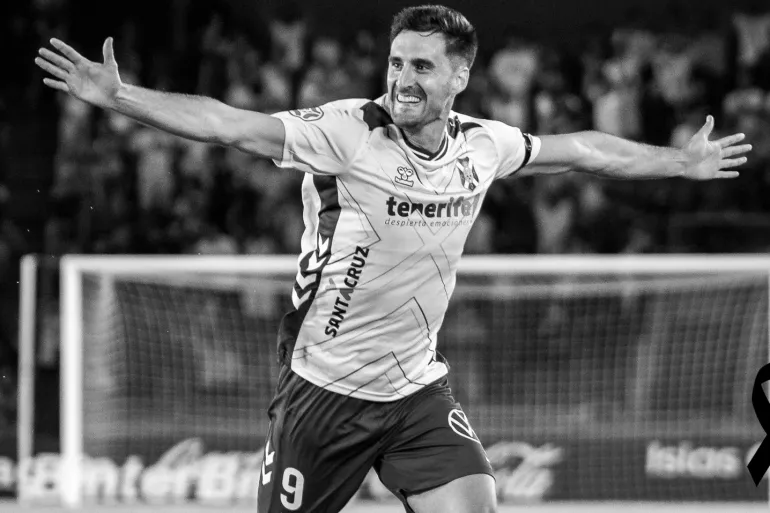
MADRID — Spanish club Tenerife announced on Tuesday morning the death of its forward Jesús de Miguel Alameda, 30, hours after he suffered a serious injury during his team's match against Andorra, a tragedy that shook Spain's sporting community.
The club said the player died at 8 a.m. local time, after spending the previous night in the intensive care unit of the Nuestra Señora de la Candelaria University Hospital on the island of Tenerife.
The Spanish striker had collided heavily with Andorra's goalkeeper in the final minutes of the match, played on Monday evening. He fell to the pitch and lost consciousness.
The medical team intervened urgently to try to save the player before he was taken to hospital, amid shock and concern among his teammates and the opposing players.
According to Al Jazeera Net, citing the Spanish press, Tenerife initially announced that its player's condition was stable though serious. It then deteriorated overnight, and his death was announced.
Violent collision in the 96th minute
The incident happened during the match between Tenerife and Andorra at the Heliodoro Rodríguez López stadium, part of Spain's second-division football league.
In the 96th minute, de Miguel tried to reach a long ball and break away on a counterattack, while Andorra goalkeeper Jesús Owono came out of his penalty area to clear it.
As both players went for the ball, the goalkeeper rushed toward the striker with his knee raised, causing a heavy collision that struck de Miguel in the upper body.
The player fell to the pitch unconscious, a scene that caused great concern among players and coaching staff.
The medical team rushed to provide first aid, while the match was stopped so the emergency could be dealt with.
Later developments showed the injury was more serious than it appeared in the first moments, after the player suffered health complications that required his urgent transfer to hospital.
Player's heart stopped as efforts were made to save his life
Spanish reports said de Miguel suffered a cardiorespiratory arrest that required paramedics to carry out resuscitation.
Medical efforts succeeded in restoring his pulse before he was taken to hospital for further treatment and monitoring in the intensive care unit.
The club had issued an update on Monday evening saying the striker's condition was stable, although still serious.
But the situation changed overnight, when medical monitoring revealed a deterioration in his neurological condition.
On Tuesday morning, the club announced the player's death, saying medical efforts had not succeeded in saving his life.
The information published did not include a detailed final medical report identifying all the factors that led to the death.
Tenerife announces death in emotional statement
Tenerife issued an official statement mourning its player, expressing the shock and grief that has settled over everyone at the club.
Club management said de Miguel's death had left deep pain among his teammates, the coaching staff, club employees and supporters.
The statement noted the difficulty of finding words that could ease the grief of the player's family and loved ones.
The club also conveyed the family's gratitude for the messages of support and condolence they have received since the incident.
The family asked that its privacy be respected during these difficult circumstances, as news of the player's condition turned into news of his death.
The announcement was a further shock to fans who had been waiting for positive developments after he was taken to hospital.
Incident renews attention to player safety
The Spanish striker's death has renewed attention to the danger of some collisions that can occur during football matches, particularly when two players rush at high speed to contest the ball.
Injuries that cause loss of consciousness or disrupted breathing require urgent medical intervention, with the patient's condition assessed before any decision is made on moving the injured person.
In cases of cardiac arrest, the speed with which resuscitation begins and the availability of specialized medical care are key factors in attempts to save a life.
However, a rapid medical response does not necessarily guarantee the injured person's recovery, especially when the injury is severe or accompanied by serious complications.
The available information about de Miguel's condition does not allow an assessment of the medical measures taken or a determination of whether the outcome could have been changed.
The final medical details depend on specialist reports, not on the footage of the match circulating alone.
The death ends the career of a player who had achieved notable success in Spain's divisions and helped Castellón gain promotion before moving to Tenerife.
As the club and the player's family prepare to say goodbye to the late striker, the match against Andorra will remain linked to one of the saddest moments in the team's history.
More Sports



Latest from Hala Canada
- Fire on Cairo's Ring Road in Warraq kills 30 and injures 15, Egypt's health ministry says
- Toronto braces for heavy rain Thursday, possibly half the monthly average
- New international student arrivals in Canada down 80% as permit limits test Carney's research plan
- 28% of Canadian employees would struggle to meet obligations if their pay were a week late
- Hackers breach CIA system used to analyze unclassified open-source information
- Groups say Carney government is behind on firearms control commitments