
Chow and Bradford clash on housing, taxes, water and mayoral powers in final debate
The last debate before the Oct. 26 Toronto election was dominated by housing, taxes, city spending, the future of Toronto Water and the powers of the mayor.
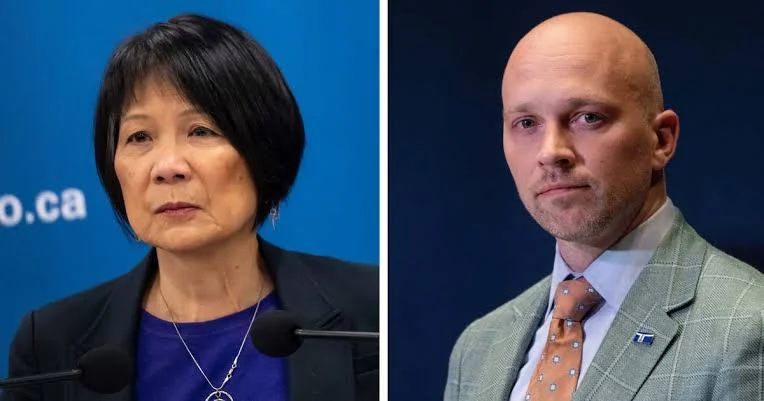
TORONTO — The final debate between the leading candidates for mayor of Toronto, Olivia Chow and Brad Bradford, on Thursday evening featured sharp exchanges over the housing crisis, rising municipal taxes, public spending and the future of water services.
The candidates also traded criticism over each other's records in municipal politics.
The debate came a few days before voters go to the polls on Oct. 26. It was the candidates' last opportunity to confront each other publicly and set out their positions on the issues that concern residents of Canada's largest city.
The confrontation focused on issues tied directly to running the city, the cost of living and the quality of public services, as each candidate tried to highlight weaknesses in his or her opponent's platform and defend his or her own political and administrative record.
Five main moments emerged from the discussion. They began with the dispute over the pace of home building, extended to the use of mayoral powers and municipal spending, and ended with the future management of water and the mutual accusations over the candidates' performance in their previous roles.
Bradford questions Chow's housing target
Housing was one of the main topics of the debate. Bradford criticized the performance of the current mayor, Olivia Chow, in delivering on her pledge to provide 65,000 rental housing units by 2030.
Bradford said the number of units delivered so far does not exceed 1,500, about 2 per cent of the stated target. He argued that at the current pace, it would take 115 years to meet the pledge.
He added that the city has seen a decline in housing starts, saying the number of projects on which construction has begun is, in his words, at its lowest level in 30 years.
Bradford said the role of city administration is to create the conditions that allow more building, and he argued that current policies have not made the progress needed to address the housing crisis.
He said Toronto knows what is needed to spur construction, but that, in his view, the city must change the way it deals with developers and housing projects so that new units can be built faster.
Chow responded by criticizing Bradford's record as chair of the Planning and Housing Committee on city council, saying the city did not see affordable housing built during his time in that post.
The mayor defended her record, saying that project approvals have been sped up by 80 per cent under her administration and that development fees have been reduced.
The disagreement reflects differing assessments of the causes of Toronto's housing crisis. Bradford focuses on the actual number of units delivered and the speed of construction.
Chow, meanwhile, points to measures she says her administration has taken to ease approvals and reduce development costs.
With the election approaching, housing is a central issue for voters, given the importance of affordable homes and a larger supply of rental units in the city.
Dispute over the use of mayoral powers
The discussion turned to the use of the mayor's expanded powers after a member of the public asked the candidates whether they would use those powers to pass decisions they consider important, even without the support of city council.
Bradford did not give a direct answer. He focused instead on his priorities of crime, traffic congestion and the cost of living, saying he is seeking a mandate from Torontonians to carry out his platform.
He said he would work with everyone to achieve those goals, a reference to his willingness to co-operate with city councillors.
Chow objected to his answer, saying she had not heard a clear response to the question.
She said she would work with councillors who disagree with her and stressed that she would not override council if a majority did not support her plan.
The dispute is significant in light of the additional powers given to Toronto's mayor under provincial legislation.
Those powers allow the use of certain tools to advance priorities linked to provincial goals, subject to specified legal conditions.
The powers raise questions about the relationship between the mayor and city council, and about the limits of executive authority when opinions are divided over a particular project or policy.
During the debate, Chow sought to present herself as a candidate who prefers to work with councillors even when they disagree.
Bradford did not say directly how he would act if he faced opposition from council on an issue he considers essential.
Bradford accuses Chow's administration of wasting money
Municipal spending and taxes took up a prominent part of the discussion. Bradford called for an independent, comprehensive review of Toronto's budget to identify spending that could be cut and to improve the efficiency of public funds.
He said the budget review should be carried out by an outside body so that the people responsible for preparing the budget are not the ones evaluating their own work.
He noted that the city's budget is now larger than the budgets of four Canadian provinces, arguing that the scale of spending makes it necessary to look for savings.
He added that the belief that there is no room for savings within a $19-billion budget reflects, in his view, an approach incapable of bringing about change.
Bradford cited several examples that he said reveal unnecessary spending, including $11 million spent on Microsoft Office licences for retired employees.
He also cited $5 million spent on stickers placed on recycling bins to tell residents that certain materials would not be collected.
He also criticized a $500,000 contract awarded to the organization Progress Toronto, accusing Chow's administration of giving the contract to groups close to her.
The accusations are part of Bradford's effort to persuade voters that a spending review could save money without raising taxes or cutting essential services.
Chow replied that her opponent's plan would not freeze municipal taxes as he presents it, but would in effect, she said, lead to a 1.5 per cent tax increase.
Chow accused Bradford of not giving an accurate picture of the financial impact of his plan. He responded by pointing out that city residents have seen a tax increase of nearly 20 per cent over three years of her administration.
The discussion thus became a confrontation over who is responsible for the rising financial burden on residents, and whether the main problem lies in the current level of spending or in the need for additional revenue to fund services.
Heated exchange over water management plan
The future of water services was among the most heated topics of the debate, as Chow defended her opposition to Bradford's plan to turn Toronto Water into an independent publicly owned corporation, similar to Toronto Hydro, which is responsible for electricity services.
Chow warned that the move could shift control of water to the Ontario government led by Doug Ford and could open the door to privatization of the service in the future.
Bradford responded by accusing his opponent of using misleading information and what he called irresponsible accusations. He said provincial law does not allow the privatization of the city's water in the way Chow described.
He said describing his plan in this way does not reflect its content, adding that the disagreement should be based on the details of the proposal rather than on accusations about his intentions.
Bradford stressed that his plan would keep water publicly owned, and he went so far as to pledge to resign from office if the service were moved into private ownership.
The dispute centres on the administrative form water services should take, and on how far creating an independent publicly owned corporation could improve the management of investment and operations.
On the other side are concerns that changing the institutional structure could reduce the city's control over one of its most important basic services.
For Chow, the issue concerns the potential risks to public ownership and local control.
Bradford, for his part, presents his proposal as a way of reorganizing how the service is managed and denies that its purpose is to open the way to privatization.
The disagreement was not limited to the technical details of the plan. It extended to mutual accusations about credibility and the way the campaign is being run, making water one of the most tense moments of the debate.
Chow criticizes Bradford's record on city council
In another confrontation, Chow criticized Bradford's record as a city councillor, arguing that becoming mayor requires a clear record of achievement in one's current job.
She said a candidate seeking the city's top office should be able to carry out his earlier responsibilities competently, a reference to what she described as his failure to deal with residents' problems.
Chow accused Bradford of not setting aside enough time to meet residents who had raised concerns about conditions in an apartment building in his ward.
Bradford rejected the accusations, calling them untrue, and criticized what he considered personal attacks not based on facts.
He said he has been working to reach out to tenants who have faced problems since 2010, and that he has followed dozens of legal proceedings against property owners he accuses of neglect.
He cited the case of a landlord he described as among the worst in Toronto, noting that the landlord faces a fine of more than $1 million and that, by his account, the charges in the case were laid before Chow visited the site.
Bradford accused his opponent of exploiting the issue for electoral purposes, saying her statements do not match the facts he knows from following the file.
The exchange reveals each candidate's attempt to shift the debate from future promises to an assessment of the rival's record in handling municipal files.
While Chow focused on Bradford's responsibility to residents in his ward, he defended his experience in dealing with tenants' complaints and pursuing landlords he accuses of neglecting their properties.
With the final debate over, voters have limited time to weigh the candidates' positions on housing, taxes, spending and public services before voting on Oct. 26.
The confrontation showed that the disagreement between Chow and Bradford is not only about the goals Toronto should pursue.
It also extends to how to achieve them, the nature of the powers the mayor should use, and who bears responsibility for the financial and housing challenges facing the city.
More Greater Toronto


Latest from Hala Canada
- Canada gives provinces 139 days to nominate tens of thousands of workers for permanent residence
- Newfoundland and Labrador issues 98 new immigration invitations in Nov. 19 round
- Trump administration weighs targeting Iranian leaders to end war, with divisions in Washington over risks
- Report: 82% of Canadian grandparents give financial help to children and grandchildren
- Former London, Ont., councillor Mariam Hamou sentenced to probation in case involving mayor
- Canada to pay $5,000 bonuses to eligible trades workers: eligibility and how to apply