
Carney says Ottawa respects Supreme Court independence after ruling upholding most of Quebec's Bill 21
Prime Minister Mark Carney said he respects the Supreme Court's independence after it upheld most of Quebec's secularism law, and stressed his government's commitment to protecting constitutional rights.
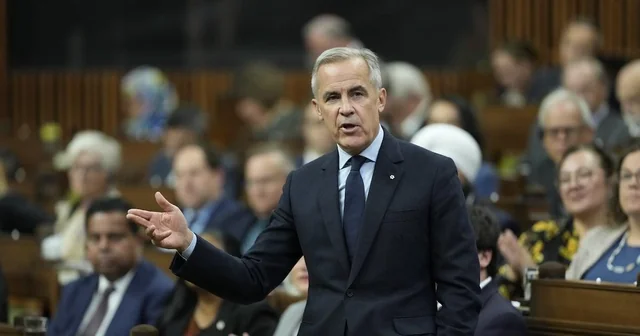
OTTAWA — Prime Minister Mark Carney has affirmed his respect for the independence of the Supreme Court of Canada after a landmark ruling that upheld most provisions of Quebec's secularism law, which bars certain categories of public-sector employees from wearing religious symbols at work.
Carney's position, stated on Friday, Nov. 27, came after the country's top court settled a years-long constitutional dispute over the law known as Bill 21. The law has deeply divided those who defend the secularism of state institutions and those who criticize the restrictions it places on freedom of belief.
The prime minister stressed the importance of respecting the judicial institutions and the provisions of the Constitution, while affirming his government's commitment to defending the Canadian Charter of Rights and Freedoms.
He also highlighted the importance of constitutional protection for minorities and the most vulnerable groups, as debate continues over the law's effect on Muslim women who wear the hijab and on members of other religious minorities.
His position comes after the court found that Quebec properly used its constitutional powers to shield most provisions of the legislation from challenges based on certain rights and freedoms.
Carney affirms respect for judicial independence
In his remarks on the ruling, Carney said the federal government respects the independence of the Supreme Court and its authority to interpret the Canadian Constitution.
He pointed to the importance of the clarifications the justices provided on how governments may use the notwithstanding clause, known as section 33 of the Canadian Charter of Rights and Freedoms.
The section gives Parliament and provincial legislatures an exceptional power to override certain constitutional rights for a limited period, under the conditions set out in the Constitution.
The prime minister said that protecting constitutionally guaranteed rights is particularly important when it comes to minorities and people most at risk of being marginalized.
This position does not mean constitutional rights are limited to certain groups, since the Charter guarantees fundamental freedoms to all individuals. The discussion, however, focuses on the groups that may be affected more heavily by government restrictions.
Supreme Court upholds most of Bill 21
The Supreme Court issued its ruling on Nov. 27, 2026, in the case of the English Montreal School Board against the Government of Quebec.
The court confirmed the validity of most provisions of the secularism law the province adopted in 2019.
The law bars some employees in positions that represent state authority, including teachers, police officers and judges, from wearing religious symbols while performing their duties.
The restrictions cover the Islamic hijab, the Sikh turban, the Jewish kippah and Christian crosses, when they fall within the symbols covered by the legislation.
The court found that the Quebec government used the notwithstanding clause in a constitutional manner to protect the law from some challenges based on the Charter of Rights and Freedoms.
However, the ruling was not a full endorsement of every provision. The court struck down a specific provision concerning members of Quebec's National Assembly.
Key exception concerns members of Quebec's legislature
The court concluded that section 8 of the law, as applied to members of the National Assembly, violates the democratic rights protected by section 3 of the Canadian Charter.
The section required faces to be uncovered while carrying out parliamentary duties, which could prevent some elected members from taking part in the work of the legislature for reasons linked to their religious beliefs.
The court held that democratic rights tied to running for election and carrying out legislative duties cannot be overridden by using section 33.
The justices therefore struck down the application of this requirement to members of the National Assembly, while leaving the rest of the law's core provisions in place.
Justices differ on the law's effect on rights
Although most of the justices agreed on the validity of the use of the notwithstanding clause, differences emerged over how to assess the law's effect on fundamental freedoms.
Some justices found that the law conflicts with freedom of religion and that the restrictions on religious symbols create professional obstacles for some citizens.
Three justices also found that the law affects gender equality in an unequal way, given its impact on Muslim women who wear the hijab.
However, the majority of the court did not issue a formal declaration that the law conflicts with protected rights, although it confirmed that courts have the power to issue such declarations even when the notwithstanding clause is used.
This means the court upheld the constitutionality of the legal framework Quebec used, without adopting every provision of the legislation as necessarily consistent with all fundamental rights.
Mixed reactions across Canada
The ruling drew varied reactions from government institutions and civil rights groups.
Supporters of the secularism law welcomed the decision, saying it strengthens Quebec's authority to set the rules governing the neutrality of its public institutions.
These groups see the separation of religion and government authority as part of the model the province chose to govern its public sector.
Rights organizations and representatives of religious minorities, on the other hand, expressed disappointment and warned of continuing obstacles for people who wish to do their jobs while remaining true to their beliefs.
The Canadian Muslim Forum said the ruling raises concerns about freedom of religion, women's rights and equal employment opportunities.
Critics of the law also noted that the restrictions may affect the ability of educational institutions to hire some qualified teachers.
Could the secularism law be repealed in future?
Despite the Supreme Court's final ruling, the decision does not end the political debate over the legislation.
The court confirmed the validity of using the notwithstanding clause, but the clause must be renewed within the constitutionally set time limits.
The Quebec government and the National Assembly remain responsible for legislative decisions on keeping or amending the law in future.
Opponents can also continue to call for change through political institutions, elections and public debate.
The case carries significance beyond Quebec's borders, because it illustrates the relationship between the powers of elected governments and the role of the courts in reviewing legislation that affects fundamental rights.
Follow Hala Canada for the latest news from Canada, every day.
More Canada


Latest from Hala Canada
- Ontario confirms ODSP disability payment date for November 2026
- Ratehub names best credit cards in Canada for 2027, with American Express Cobalt leading rewards
- Manitoba premier calls Quebec's secularism law 'legislative racism' after Supreme Court ruling
- Woman killed, off-duty officer seriously injured as Tesla crashes into Vancouver restaurant
- Ottawa to host first ACTION+ Youth Summit on Jan. 9, 2027, linking young people to careers
- New Canadian citizenship law could open the door to entire American families