
Canada announces 2027 federal income tax brackets, with thresholds up 2.6%
The Canada Revenue Agency has released the 2027 federal brackets, raising income thresholds by 2.6% to keep pace with inflation, which will lower some Canadians' tax bills.
Translated from Arabic. Read the original بالعربية
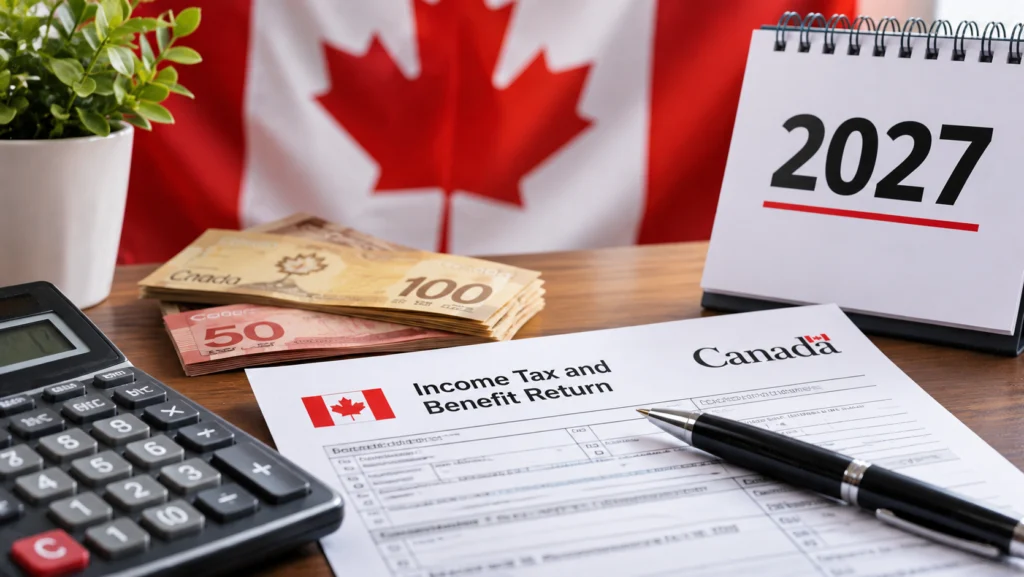
OTTAWA — The Canada Revenue Agency (CRA) has announced the new federal income tax brackets for 2027, which raise the taxable income thresholds by 2.6% to keep pace with inflation.
The changes are scheduled to take effect on January 1, 2027, allowing Canadians to earn more income before moving into the next tax bracket.
The adjustments come as Canadian households continue to face financial pressure from rising living costs, including housing, food and essential services.
Bracket thresholds raised by 2.6%
On November 19, the CRA published the 124th edition of its guide for calculating payroll tax deductions.
The new adjustment is based on Consumer Price Index data from Statistics Canada.
The government raised the bracket thresholds by 2% in 2026, compared with 2.7% in 2025 and 6.3% in 2023.
These annual adjustments are intended to protect people's purchasing power and limit the effect of inflation on their tax obligations.
Federal tax rates remain unchanged, while the income levels to which those rates apply are rising.
New income tax brackets in Canada for 2027
The CRA has set the new federal tax brackets as follows:
- 14%: income up to $60,044 in 2027 (up to $58,523 in 2026)
- 20.5%: income up to $120,088 in 2027 (up to $117,045 in 2026)
- 26%: income up to $186,157 in 2027 (up to $181,440 in 2026)
- 29%: income up to $265,203 in 2027 (up to $258,482 in 2026)
- 33%: income above $265,203 in 2027 (above $258,482 in 2026)
Canada's tax system is progressive, meaning each portion of income is taxed at the rate set for the bracket in which it falls.
For example, a person earning $80,000 will not have all of their income taxed at 20.5%.
The first $60,044 will be taxed at 14%, and the higher rate will apply only to the remainder.
Increase in the basic personal amount
The changes include raising the maximum basic personal amount to $16,879 in 2027, from $16,452 this year.
The increase of $427 provides an additional federal tax reduction of up to about $60 for those eligible for the full amount.
Higher-income earners will receive a gradually reduced basic personal amount.
The minimum amount will be $15,214 next year, compared with $14,829 in 2026.
How much will Canadians save on taxes in 2027?
The expected tax savings vary depending on each person's annual income.
Estimated calculations point to the following annual savings:
- $40,000 annual income: $59.78 in savings
- $60,000 annual income: $155.79 in savings
- $80,000 annual income: $158.65 in savings
- $100,000 annual income: $158.65 in savings
- $150,000 annual income: $326.01 in savings
These estimates are limited to federal income tax and take into account the basic personal amount tax credit.
The calculations do not include provincial taxes or other deductions and tax credits, which vary according to each taxpayer's personal and family circumstances.
Tax changes differ across provinces
The tax changes will not be identical across Canada, as provinces and territories use their own brackets and rates.
Provincial bracket thresholds are scheduled to rise by 2.1% in Ontario, 2% in Alberta and 3.5% in Nova Scotia.
By contrast, bracket thresholds in Manitoba, Prince Edward Island and British Columbia will not be adjusted for inflation in 2027.
Quebec uses a separate system to administer its provincial income tax.
When will the changes show up in paycheques?
Employers will begin applying the new deduction tables starting next January.
Some employees are expected to see a decrease in the amount of income tax deducted from their pay, without needing to submit any special requests to benefit from the changes.
However, net pay will also continue to depend on pension contributions, employment insurance premiums and other deductions.
The new brackets will be used when filing 2027 tax returns, during the 2028 tax season.
What the changes mean for newcomers
The changes are particularly relevant for newcomers preparing to enter the Canadian labour market or to file their first tax returns.
Understanding the new brackets helps in estimating annual net income and planning family expenses more effectively.
Self-employed workers are also advised to review their expected tax obligations to avoid overpaying or facing unexpected amounts owing.
Although the adjustments will not fully offset higher living costs, they provide some relief from tax burdens, particularly for middle-income workers.
More from Hala Canada
- Manitoba invites 1,050 Ukrainian nationals to apply under its provincial nominee program
- Calgary man pleads guilty in case involving death threats against Prime Minister Carney
- Eight people arrested in Toronto thefts of seniors' jewellery using distraction tactics
- Alto high-speed rail project could add $24.5 billion a year to Canada's economy, study says
- Coyote attacks child and drags them in Edwards Gardens in Toronto, police say
- B.C. man found in contempt after moving $44.9 million to brother using two sticky notes