
Emergency alert test to sound on phones across Canada on Wednesday, Nov. 18
Canada will test its Alert Ready emergency alert system on Wednesday, Nov. 18, 2026, through phones, television and radio in all provinces and territories, with times varying by region.
Translated from Arabic. Read the original بالعربية
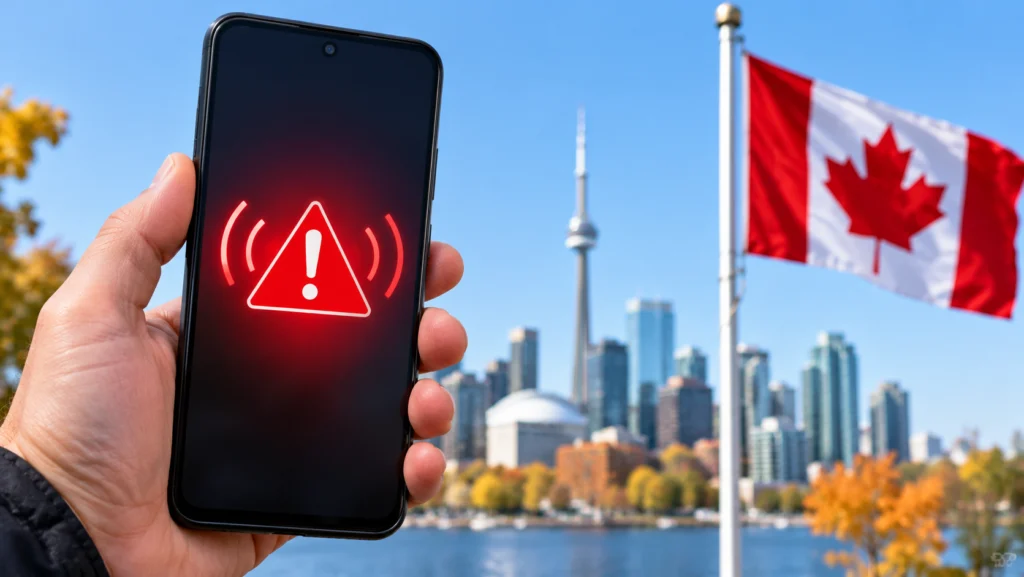
OTTAWA — Millions of people across Canada are preparing to receive emergency alert messages on their mobile phones on Wednesday, Nov. 18, as part of a national test of the hazard warning system known as Alert Ready.
Compatible phones are expected to emit a loud, distinctive sound, along with a message confirming that the alert is only a test and does not signal a real danger.
The alert will also be broadcast on television and radio stations in the provinces and territories.
The agencies overseeing the system said the test will cover all provinces and territories, but the times at which messages are received will vary by geographic region.
Residents do not need to take any action when the test message appears.
When will the emergency alert reach phones in Canada?
The agencies overseeing the Alert Ready system have set the following times for the test on Wednesday, Nov. 18, 2026.
- Ontario: 12:55 p.m.
- Quebec: 1:55 p.m.
- British Columbia: 1:55 p.m.
- Alberta: 1:55 p.m.
- Saskatchewan: 1:55 p.m.
- Manitoba: 1:55 p.m.
- New Brunswick: 10:55 a.m.
- Nova Scotia: 1:55 p.m.
- Prince Edward Island: 12:55 p.m.
- Newfoundland and Labrador: 9:55 a.m.
- Northwest Territories: 1:55 p.m.
- Yukon: 1:55 p.m.
- Nunavut: 1:55 p.m. Eastern time
These times are based on the official schedule that was announced. Timing details may differ in areas that span more than one time zone.
The local emergency management authorities will send the messages to residents within their geographic areas.
What will happen when the alert arrives?
When the test begins, a message will appear on the screen of mobile phones, accompanied by a loud tone similar to the one used in real emergencies.
The alert will state clearly that it is only a test.
Some television and radio programs will be briefly interrupted to display the test message.
The aim is to familiarize residents with how the system works so they can recognize official signals when a real danger occurs.
The Government of Nova Scotia said the test may briefly interrupt the use of devices or broadcasts, but it does not require any response from the public.
Will all phones receive the message?
The message is expected to reach compatible mobile phones connected to fourth-generation LTE or fifth-generation 5G networks.
Some users may not receive the alert for technical reasons.
These include an incompatible device, weak cellular coverage, phone settings, or a phone not being connected to the required network at the time of the test.
A message that does not arrive does not necessarily mean there is a problem with the emergency system nationally.
Users can check whether their phones are compatible on the system's official website.
Bell also said that people do not need to register in advance to receive the alerts.
Can emergency alerts be turned off in Canada?
The agencies overseeing the system said users cannot opt out of Alert Ready or disable mandatory alerts under the approved distribution system.
This is because the messages are designed to reach residents quickly when their lives or property are at imminent risk.
However, device settings and compatibility may affect how some alerts appear or sound.
The test sound may be startling, particularly in schools, workplaces, hospitals and on public transit.
Why does Canada test the system twice a year?
Canada usually holds periodic tests in May and November to ensure the alert distribution channels are ready.
Alert Ready is used to warn of situations that include floods, tornadoes, major fires and security threats.
It is also used to issue AMBER Alerts to help find abducted children when cases meet the required criteria.
The tests help assess the performance of telecommunications companies, broadcasters and the government agencies responsible for emergency management.
They also give residents a chance to become familiar with what the messages look and sound like.
According to the company that operates the system's technical infrastructure, more than 1,215 emergency alerts have been sent across Canada since the start of 2026.
Important notice about hidden phones
Police agencies have warned that the sound of an emergency alert could reveal a hidden phone or tablet kept by a person experiencing domestic violence.
For this reason, the agencies concerned advise people who rely on hidden devices as part of a personal safety plan to take appropriate precautions before the test.
This may include temporarily turning the device off completely if the alert sounding could put its owner at risk.
The point is important because the test covers wide areas of Canada, and the alert may reach even devices that their owners are not using openly.
What should people do on Wednesday?
Authorities said residents are not required to contact police or ambulance services when they receive the test message.
They also urged people not to call 911 to ask about the test, so that response lines are not tied up and remain available for real emergencies.
If a warning message arrives without a clear indication that it is a test, people should read its content and follow the official instructions it contains.
Wednesday's test remains a routine precautionary measure intended to ensure the system is ready in the event of actual disasters or threats.
More from Hala Canada
- Canadian salaries expected to rise about 3% to 3.4% in 2027, reports say
- Toronto selects 19 projects for nearly 10,000 rental homes, including about 2,000 affordable units
- Three dead, including two children, after house fire in Burlington, Ont.
- Palestinian Arab Association marks International Day of Solidarity with the Palestinian People in Mississauga
- Montreal gas prices fall to lowest level in eight months
- Five novels compete for the $100,000 Giller Prize at Toronto ceremony