
Euclid telescope data reveal more than 900 million galaxies, European Space Agency says
The agency's first major Euclid release includes 15,000 possible strong gravitational lenses and aims to help scientists understand dark matter and dark energy.
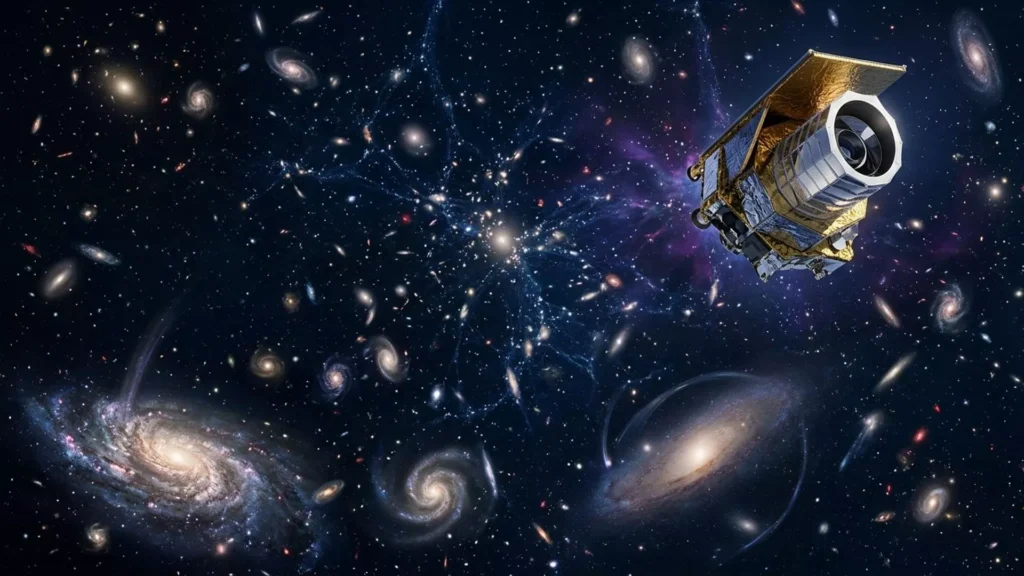
Hala Canada — The European Space Agency has announced a major scientific milestone after the first major batch of data from the Euclid space telescope showed more than 900 million galaxies, an unprecedented step toward a three-dimensional map of the universe.
On Nov. 12, 2026, the agency released a huge set of data collected by the mission over about 13 months of observation, giving scientists a chance to study the structure and evolution of the universe in greater detail.
The project aims to help explain dark matter and dark energy, which together make up most of the universe's content, even though their nature is still not fully understood.
900 million galaxies in first major release
The European Space Agency said the new data cover about 1,900 square degrees of sky, an apparent area equivalent to roughly 9,500 full moons.
That area represents about 14 per cent of the region the telescope plans to survey during its six-year scientific mission.
The results include about 10,000 scientific images, as well as light spectra for more than 160 million astronomical sources.
The published data amount to about 1.7 million gigabytes, making them one of the largest sets of astronomical observations made available to researchers.
15,000 possible gravitational lenses
One of the mission's main results is the identification of about 15,000 candidate cases of strong gravitational lensing.
The phenomenon occurs when the gravity of a massive cosmic object, such as a galaxy or a galaxy cluster, bends light coming from more distant objects.
It allows scientists to study distant galaxies and detect the effects of dark matter, which cannot be seen directly.
The number of cases observed is an important achievement, as it exceeds what was discovered over many decades of earlier studies.
However, these cases are still candidates and require further examination to confirm their nature.
60 million quasar candidates
The data also revealed more than 60 million quasar candidates.
Quasars are extremely bright regions at the centres of some distant galaxies, powered by matter flowing toward supermassive black holes.
Studying them helps scientists understand how black holes grow and how galaxies evolve through different stages of the universe's history.
These objects also provide important information about conditions in the universe billions of years ago.
A 3D map to reveal the universe's history
The Euclid telescope was launched in July 2023 with the aim of drawing one of the widest three-dimensional maps of the universe.
The mission seeks to study billions of galaxies across more than 10 billion years of cosmic history, to understand how matter is distributed and how the universe expands.
Researchers hope precise measurements will reveal the influence of dark matter on the formation of galaxies and the role of dark energy in the accelerating expansion of the universe.
The published data are a foundational step in the project, and further scientific results are expected in the coming years.
The European Space Agency stressed that the volume of new information opens wide horizons for researchers, but does not mean the mysteries of dark matter and dark energy have already been solved.
More Science & Tech




Latest from Hala Canada
- Cadbury chocolates recalled across Canada over possible undeclared pistachios
- Montreal's 2027 draft budget proposes average 9.8% residential property tax increase
- Nvidia reinstates Jensen Huang as CEO after Trump intervenes, surprising tech markets
- Snow squall watch for Barrie area in Ontario, with up to 15 cm of snow and near-zero visibility
- Jensen Huang reinstated as Nvidia CEO; shares up about 30% before market open
- Canada and Qatar to hold first strategic dialogue in Ottawa on security, investment and Gulf developments