
Astronomers find unseen object in Cetus up to 2.8 times the mass of the Sun
An international team has found an invisible object 4,730 light-years away in the constellation Cetus, and its nature and formation remain unclear.
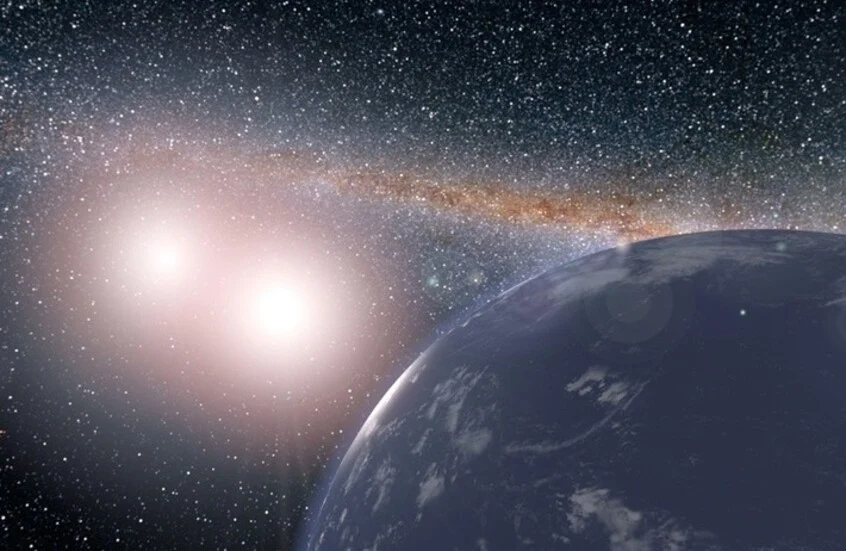
BEIJING — An international team of astronomers has announced the discovery of a mysterious, unseen celestial object in the constellation Cetus, with a mass that may reach 2.8 times that of the Sun. The finding raises new questions about how neutron stars and black holes form.
The object sits in a binary star system about 4,730 light-years from Earth and accompanies a red giant star, but scientists were unable to observe it directly.
The research results were published in the journal Science Advances, after measurements revealed unusual properties that are difficult to explain with current models of stellar evolution.
An invisible object with enormous mass
The system, named J0008+0128, consists of a red giant star and a companion object that does not appear in optical observations.
The researchers estimated the mass of the hidden object at between 1.8 and 2.8 times the mass of the Sun, with a most likely estimate of about 2.2 times.
These figures make the object a candidate for a very massive neutron star, or possibly a low-mass black hole.
The scientists observed that the two stars orbit their common centre of mass in a nearly circular orbit, completing one revolution in about 1,218 days, or roughly 3.3 years.
The combination of large mass and a wide orbit is one of the main aspects that puzzled the research team.
Discovery raises the "mass gap" puzzle
The discovery is significant because the object may lie within a range known in astronomy as the "mass gap," a region where the nature of the compact objects found there is still under study.
Neutron stars usually form after the cores of massive stars collapse at the end of their lives, and they are exceptionally dense.
Black holes form when matter collapses under gravity into a state from which light cannot escape.
Scientists are trying to determine the maximum mass a neutron star can sustain before collapsing into a black hole.
The new object could help test these limits, especially if it is confirmed to be a neutron star more massive than most known ones.
Chinese and American telescopes help uncover the puzzle
Researchers from China, Australia, Europe and the United States took part in the study, led by a team affiliated with the National Astronomical Observatories of the Chinese Academy of Sciences.
The scientists used data from China's LAMOST telescope, along with observations from the APOGEE project at the Apache Point Observatory in the United States.
They also drew on measurements from the European Gaia observatory, which tracks the positions and motion of stars with high precision.
These instruments helped the researchers detect the gravitational effect of the hidden object on the motion of the red giant.
By analyzing changes in the visible star's velocity and its motion through space, the scientists were able to estimate the properties of its companion without seeing it directly.
Thousands of simulations fail to explain how the object formed
The scientists' puzzlement was not limited to the object's mass but extended to how it reached its current orbit.
The researchers ran thousands of computer simulations to try to reconstruct the evolution of the star system, but the models tested did not fully explain its properties.
One possibility is that a very massive neutron star formed as a result of an unusual stellar explosion.
Another possibility assumes the system was previously made up of three stars, before two of them merged and left behind a very massive object.
These scenarios remain scientific hypotheses that require more evidence, and they do not represent a confirmed explanation of the system's history.
Could the discovery change theories of stellar evolution?
The discovery of J0008+0128 may help improve understanding of matter under immense pressures and densities inside neutron stars.
It also provides a new test for models that explain stellar explosions, the evolution of binary systems and the merging of celestial bodies.
The researchers are awaiting more precise data from the Gaia space mission to help narrow the estimates of the object's mass and determine its nature.
If it is confirmed to be a very massive neutron star, that could place new constraints on theories about the stability of such stars.
If it proves to be a small black hole, it would in turn provide important information about objects at the boundary between neutron stars and black holes.
Until then, the mysterious object remains one of the discoveries showing that scientists' understanding of stellar evolution still requires further research.
More Tech



Latest from Hala Canada
- Canada gives provinces 139 days to nominate tens of thousands of workers for permanent residence
- Newfoundland and Labrador issues 98 new immigration invitations in Nov. 19 round
- Trump administration weighs targeting Iranian leaders to end war, with divisions in Washington over risks
- Report: 82% of Canadian grandparents give financial help to children and grandchildren
- Former London, Ont., councillor Mariam Hamou sentenced to probation in case involving mayor
- Canada to pay $5,000 bonuses to eligible trades workers: eligibility and how to apply