
Ford sends urgent letter to Carney warning against assembling Chinese vehicles at Brampton plant
Premier Doug Ford is urging Prime Minister Mark Carney to block assembly of Chinese electric vehicles at the Brampton plant, amid fears of lost auto jobs in Ontario.
Translated from Arabic. Read the original بالعربية
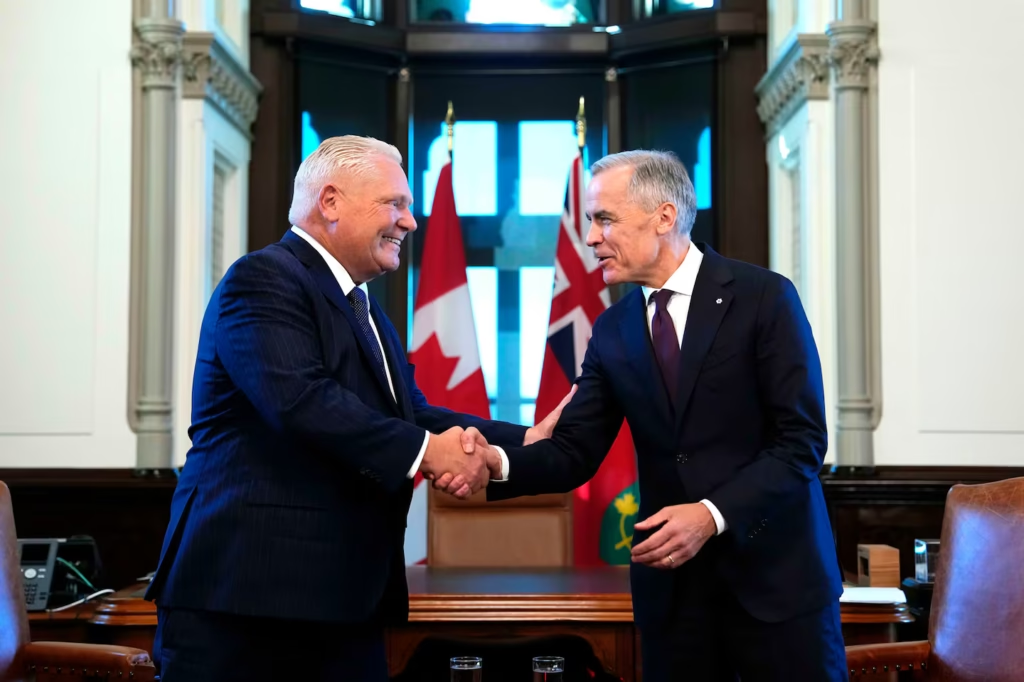
TORONTO — Ontario Premier Doug Ford has stepped up pressure on the federal government over the future of the Brampton auto plant. He is demanding a guarantee that the facility will not be used to assemble Chinese electric vehicles arriving in Canada as ready-made kits of parts.
Ford's position was laid out in a letter to Prime Minister Mark Carney on Wednesday, Nov. 11, 2026. It followed the announcement of an agreement to sell Stellantis's idled plant to Roshel, a Canadian maker of armoured vehicles.
Ford calls for protection of Ontario's auto industry
Ford believes that restarting the plant must mean real industrial jobs, not simply installing components made almost entirely abroad.
The premier fears that this model would bring activity back to the plant building without restoring the jobs tied to the vehicle and auto parts production chain inside the province.
Ford had said in remarks on Monday, Nov. 9, that he rejected importing Chinese vehicle kits to be assembled in Brampton, arguing that such a move could harm the local auto sector. He also called at the time for a suitable model to be found that could be built at the facility.
Why Chinese vehicles worry workers
This method of vehicle production is known as assembly from disassembled kits. The vehicle's components arrive from abroad, and local work is limited to a few assembly stages.
Critics warn that it does not provide as many jobs as building vehicles with a broad network of local suppliers, including the production of bodies, components and various systems.
The union Unifor expressed similar concerns last April, following reports that Stellantis might work with China's Leapmotor to produce electric vehicles in Brampton.
Federal Industry Minister Mélanie Joly said at the time that any project must support the Canadian supply chain, stressing that importing vehicles as ready-made kits does not meet the goal of restarting production.
Sale of Brampton plant opens a new dispute
On Nov. 9, Stellantis and Roshel announced they had signed an agreement to sell the plant and its equipment for an undisclosed sum. The deal is expected to close before the end of the year, once the necessary conditions and approvals are met.
The two companies said the agreement aims to put the site back to industrial use, while exploring future opportunities to work together on vehicle technologies and in the defence sector.
Roshel says it plans to turn the site into an advanced manufacturing hub serving Canadian companies and foreign markets. However, this vision does not in itself mean a return of the plant's former passenger-vehicle production lines.
Stellantis says it is prepared to negotiate with the union on a settlement that takes into account employees' rights and the company's legal obligations.
But the plant is a sensitive issue for workers. Production stopped there in late 2023 for retooling, and plans to restart it were later put on hold. Stellantis subsequently moved production of the Jeep Compass to the United States.
More than 2,000 workers were affected by the shutdown, amid fears that the new activities will not bring back the same jobs or former working conditions.
Carney criticizes the deal as workers demand guarantees
Prime Minister Mark Carney described the decision to sell the plant as unacceptable and a betrayal of the company's commitments to its workers and to Canada. He said the government is prepared to use its legal rights to protect workers and hold the company to account.
Unifor also criticized the deal, arguing that converting the site to defence vehicle production does not automatically replace auto jobs or the economic benefits the plant provides to supplier companies.
For its part, Roshel announced its intention to develop industrial activity at the site, while details of the final number of jobs and the terms for hiring former workers remain to be settled.
Meeting expected on the plant's future
A meeting is scheduled for Thursday, Nov. 12, bringing together representatives of the government, Stellantis, the union and other stakeholders to discuss the fate of the workers and the next steps.
Ford's letter comes amid a broader dispute over the role of Chinese electric vehicles in the Canadian market, after Ottawa's decision to allow a limited number to be imported at a reduced tariff.
The new trade framework allows up to 49,000 Chinese electric vehicles to be imported each year at a tariff of 6.1 per cent, instead of the previous high tariffs. But the current dispute concerns the nature of manufacturing inside Canada, not simply whether finished vehicles may be imported into the domestic market.
For Brampton workers, the key question remains: will reuse of the plant lead to stable production jobs and a strong Canadian supply chain, or will it be limited to industrial activity that does not make up for what the city has lost?
More from Hala Canada
- Union report finds staffing shortages in all 72 Ontario school boards, with fewer supports for students
- Pilot dies in small plane crash near Saint-Georges, Quebec, on Remembrance Day
- Federal budget proposes $50-billion emergency insurance facility for a catastrophic earthquake
- Young man sentenced to 5½ years in prison for shooting at Montreal Jewish school
- Budget 2026 omits pledge to double home building as Ottawa sets new non-market housing target
- Dunkin' returns to Canada after eight years; building permits reveal Toronto location