
Cyberattack raises fridge temperatures to 50 C in stores across Europe
Dozens of supermarkets in several European countries were hit by cyberattacks on refrigeration and freezer systems, with some units reaching 50 degrees Celsius.
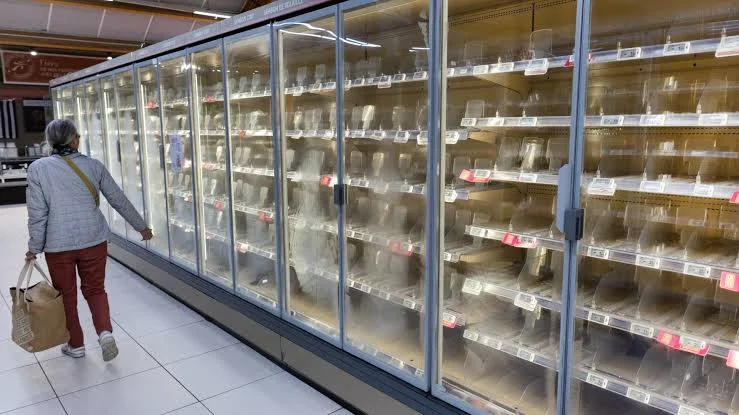
STOCKHOLM — Several European countries have seen a new wave of cyberattacks targeting refrigeration systems inside large supermarkets, after hackers manipulated the settings of internet-connected fridges and freezers and caused their temperatures to rise abnormally.
The faults appeared on the morning of Monday, Nov. 2, in stores in Sweden, Belgium, Luxembourg, Ireland and Estonia, with similar disruptions recorded in other European countries.
The incidents forced some stores to throw out refrigerated and frozen products that had been exposed to high temperatures and may no longer be fit for consumption.
Authorities have not yet said who is responsible for the attacks, and a direct link to the attack that hit hundreds of French stores last October has not been confirmed.
Freezer temperatures rise to 50 C
In Sweden, the ICA supermarket chain said a limited number of its stores experienced disruptions to their refrigeration systems overnight.
One of the chain's stores in the southern city of Sjöbo said its refrigeration and freezer systems had been breached and that temperatures were set to 50 C, equivalent to 122 F.
Staff had to remove the affected food products and discard items whose safety could no longer be guaranteed.
In Stockholm, Ingela Ingvall, a sales manager at an ICA store, said the attack took place at around 2 a.m. but was not discovered until several hours later.
She said all of the freezers in the store reached high temperatures, damaging their contents.
The Swedish chain Coop also reported similar problems in a number of its stores, while the relevant authorities began reviewing the nature of the fault and its effect on the refrigeration systems.
Dozens of stores affected in Belgium and Luxembourg
The disruptions extended to Belgium and Luxembourg, where the Ahold Delhaize group said refrigeration systems in dozens of its stores experienced technical problems overnight.
The company said the incident temporarily reduced the availability of some fresh and frozen products in the affected stores.
It added that its distribution centres continued to operate normally and that deliveries to stores did not stop.
Carrefour also said 15 of its more than 700 stores in Belgium experienced disruptions to their refrigeration systems.
The company said the impact was relatively limited and that it had taken steps to restore normal operations.
The disruptions also affected stores belonging to other chains, as well as an IKEA site in Belgium.
Available information indicates that the scale of losses varied between stores, depending on how long the high temperatures lasted and how quickly the problem was discovered.
Attacks reach Ireland, Estonia and Finland
The incidents were not limited to Sweden and Belgium. In Ireland, the Musgrave group said refrigeration systems were affected in 13 stores belonging to the SuperValu chain.
Some stores had to remove products as a precaution before the problem was fixed and the restocking of fridges resumed.
In Estonia, a refrigeration control system at one store was hacked, raising the temperature to 50 C.
Kitman Coldtech, a company that specializes in refrigeration systems, said its staff dealt with the incident within minutes, which helped prevent major damage.
Finland's Kesko group also said it had detected abnormal temperatures in a number of small stores, and an investigation to determine the cause is continuing.
Not all companies have confirmed that their incidents were caused by a cyberattack. Some described what happened as a technical disruption whose circumstances are still being examined.
How did hackers gain control of the fridges?
Large stores rely on electronic systems that allow the temperatures of fridges and freezers to be monitored and controlled remotely.
These technologies usually help keep food products safe, manage energy use and detect faults without a technician needing to be next to each unit.
But connecting these systems to networks can leave them open to exploitation if they contain security vulnerabilities or have not received the necessary security updates.
In some of the European incidents, the attackers apparently gained access to the control systems and changed refrigeration settings, or ran defrost programs abnormally.
Security reports indicated that some of the affected equipment uses older technology from the Danish company Danfoss.
The company had explained, after the earlier attacks in France, that some older products no longer receive software and security updates.
However, authorities have not established that all of the latest incidents resulted from the same vulnerability or were carried out by the same party.
Similar attack hit hundreds of French stores
The new wave of attacks follows a large-scale cyber incident in France on Oct. 12.
In that attack, hackers remotely manipulated refrigeration systems in hundreds of stores, causing temperatures inside freezers to rise and large quantities of food to be spoiled.
Stores belonging to well-known chains were affected, including Intermarché and Coopérative U.
French authorities opened an investigation into the incident after food losses and fires linked to some of the faults were reported.
Security reports indicate that the number of sites affected by the French attack reached about 700, according to estimates linked to the investigations.
However, the similarity between the earlier attack and the new incidents is not enough to confirm the existence of a single coordinated cyber campaign or one party behind it.
More World




Latest from Hala Canada
- Number of Express Entry candidates with more than 500 points more than doubles
- Campaign to restore prime minister's residence tops $8 million; major donors named
- Iraq offers two Saddam Hussein-era Boeing 747s for sale after 35 years in Tunisia
- Carney leaves press gallery dinner in Ottawa, drawing Conservative criticism
- Quebec judge reinstates oath to the King, clouding opening of National Assembly
- Intimate partner violence in Canada reaches highest recorded rate since 2009, Statistics Canada says